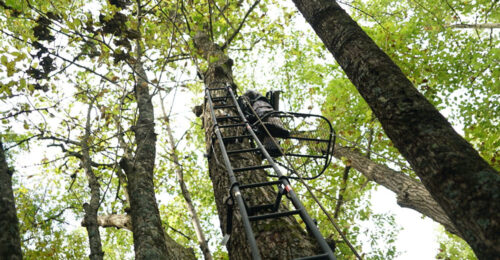
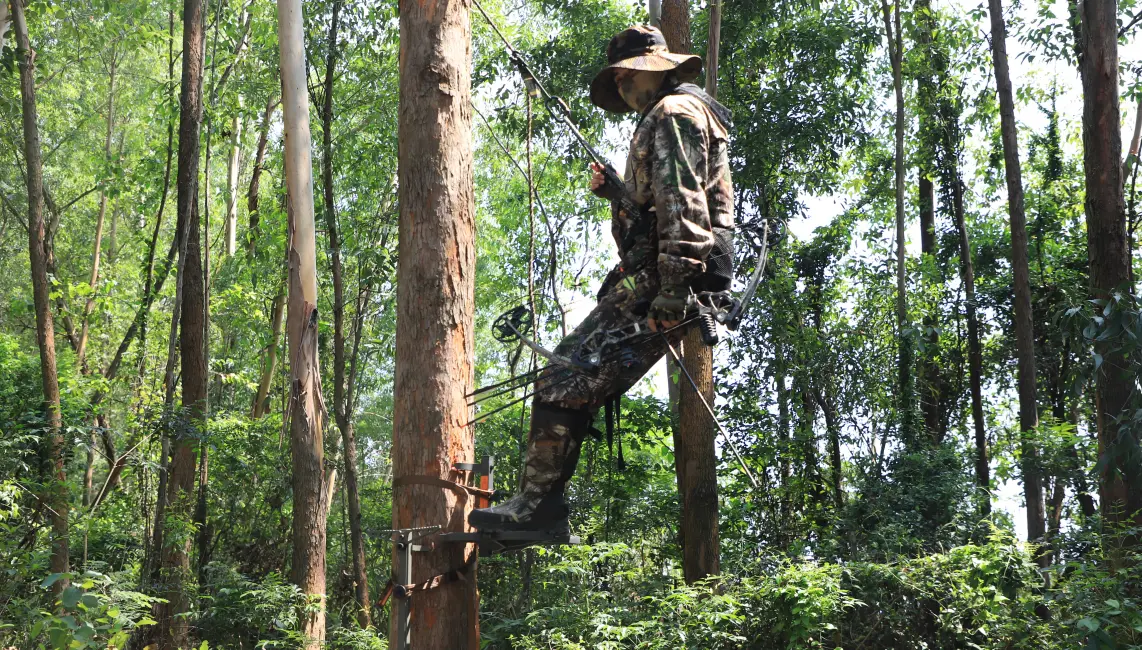
Buying a tree saddle to hunt from is the easy part. The real learning starts when you climb the tree and have to figure out where to position yourself, how to move without being seen, and how to set up a clean shooting lane.
A saddle is different from a traditional treestand. Instead of staying in one fixed position, you can work around the tree and use the trunk for concealment. But that freedom also means your position and movement matter more.
So, how are you going to hunt from your tree saddle exactly? Let’s find out together how to become familiar with your saddle’s platform height and bridge length, and make sure that you’re tied to the tree correctly and safely before opening day.
Pick the Right Tree for the Hunt
Everything downstream of tree selection is damage control. Pick wrong, and you’ll inevitably spend the whole sit fighting your position instead of actually hunting!
How Tree Selection Shapes Your Position and Your Shots
With a saddle, your position against the tree is both how the tree supports you and how you plan your shot. This means the trunk provides four things at once:
- Cover
- Support while sitting or standing
- A pivot point to rotate to your next target
- An obstacle to overcome in terms of clear shots
The size of the trunk has a bigger impact than you may realize. If the trunk is thin and small, you can easily move left or right and have a large open area to shoot through. However, this also typically means that you’ll have little to no concealment.
On the other hand, larger trunks provide better concealment, but they also greatly restrict the amount of movement you can do under those conditions (as well as the degree of difficulty in making a turn underneath them).
Typically, most hunters will find the sweet spot for their needs somewhere in the 12 to 16 inch trunk diameter range, so you can keep that in mind as a general rule of thumb.
What to Consider Besides the Tree Itself
Hunters also have to consider other factors that surround the tree, such as:
Deer Sign
Perhaps the most important thing of all is making sure that there are abundant signs of deer in the area in the first place.
Tracks, flattened areas in brush where deer have been resting, and droppings (also known as ‘scat’) are all crystal clear signs that deer regularly come through.
Be as specific as possible in that regard. “Deer come through here somewhere” does not qualify as a hunting plan. “Deer travel down that trail from the northwest, cross the creek, and then proceed southeast to the cut” is a hunting plan, and it also cleanly identifies which tree(s) in the area that you should be hanging on.
Wind Direction and Thermals
Wind direction and thermals are two more factors you need to think about.
Everyone knows about checking wind direction. Very few hunters, however, know anything about thermals. ‘Thermals’ in this context simply refers to the vertical air currents that are caused by the heating and cooling of the ground, and make no mistake, they can destroy more hunts than a crosswind ever will!
Long story short, morning thermals pull scent upward, while evening thermals move it downward. This is because as the sun warms the ground in the morning, the warmer air becomes lighter and rises up through hills and ridgelines.
Later in the day, as the sun sets and the ground cools, the air will grow denser and sink downward into the lower elevations.
What does this mean practically speaking? It means that you’ll want to hang your saddle on higher ground if you’re going to be hunting in the morning (so your scent rises away from any deer below you), and on lower ground during evening hunts (so your scent sinks away from any deer).
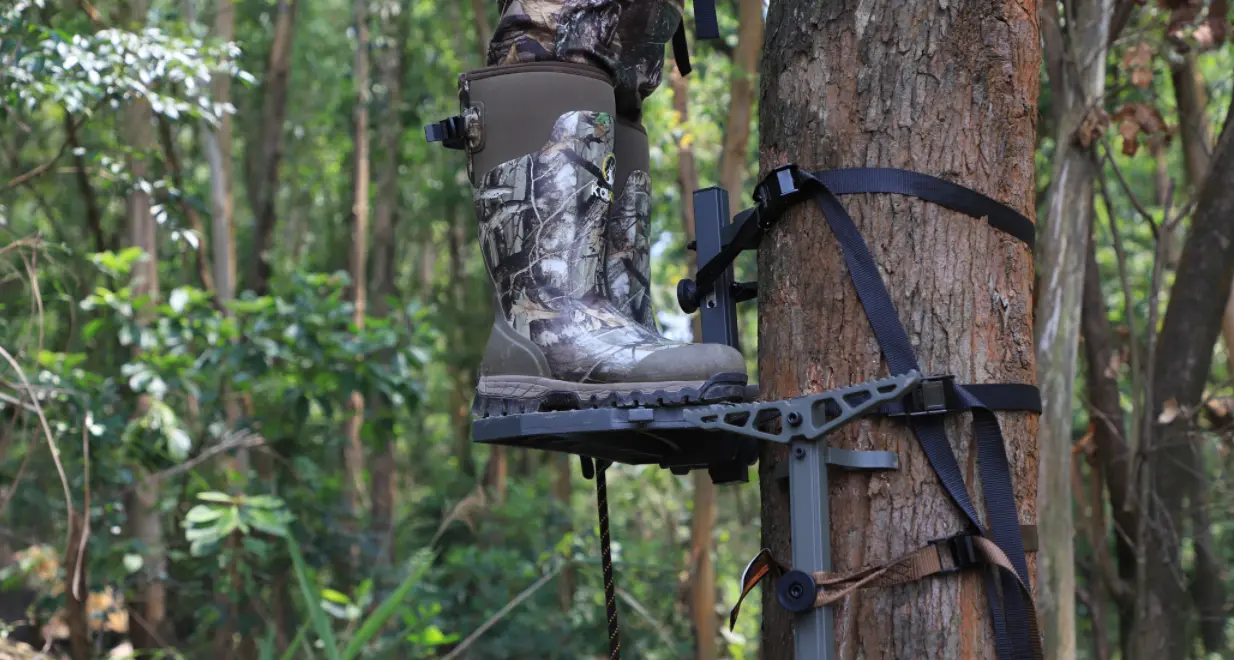
Set Up Your Position for the Shot
Don’t face the “kill zone.” It seems counterintuitive, but it’s a method that many successful hunters use.
Most novice hunters hang their stands directly over the area where they plan to take their shot without putting much thought into it.
Then when deer appear, the hunter has to adjust his or her head and shoulders to follow the deer, and then he or she must again readjust after the deer enters the “kill zone.”
Instead of being positioned at the front of the stand, orient yourself to view the path that the deer are most likely to travel down into your “kill zone” and wait for them to arrive (rather than facing the “kill zone” itself). The idea is that you’ll be watching the deer for a while before shooting.
Use the trunk to help hide you. The trunk itself provides a great deal of cover, and you can use it to conceal yourself from approaching animals until it’s time to take your shot. At that point, the deer are often looking elsewhere.
Another good idea is to position yourself to allow for enough rotation. Before you settle in for a hunt, try a mock-up of your actions. Move as far left as you can and then as far right as you can, and identify areas that limit your ability to make these moves.
Do you hit branches? Are your bow tethers getting in the way? Take care of these issues now instead of waiting for the hunt itself.
Use the Tree to Hide Your Movement
Hunters who use saddles instead of traditional tree stands typically get much more of an advantage than they realize.
For one thing, you are totally exposed when you move inside a treestand. With a saddle, however, you have a tree you can move around. And that tree provides a wall to hide behind.
This also means that you’ll need to avoid making large or sudden movements. Get comfortable in the saddle before you actually hunt by spending twenty minutes or so just sitting and moving around in it.
This is yet another reason why visiting a hunting area before hunting season and testing your saddle is such a wise idea. You never want the hunt itself to be the first time you use the equipment.
This leads us into our next tip…
Move Less, Not More
Here’s the unappealing part of saddle hunting: the same versatility (as in the ability to move) that makes saddle hunting so appealing will also create a real temptation for you to fidget, and fidgeting is practically a guaranteed way to cost you a successful hunt.
You see, a hunter who moves six times an hour is basically creating six times the amount of movement as the hunter who picks a position and stays there, and deer are very adept at detecting hunters who refuse to remain stationary because they are constantly scanning for movement.
Also, there’s a comfort aspect. A saddle is going to exert pressure on your legs and hip areas, which is why your most likely reaction is going to be to adjust and shift your body around.
Most new saddle hunters continually shift positions in their first few “sits,” until they have learned how to properly use the straps on their legs and how to stand on the platform. Again, this is why you should practice using your saddle before you hunt.
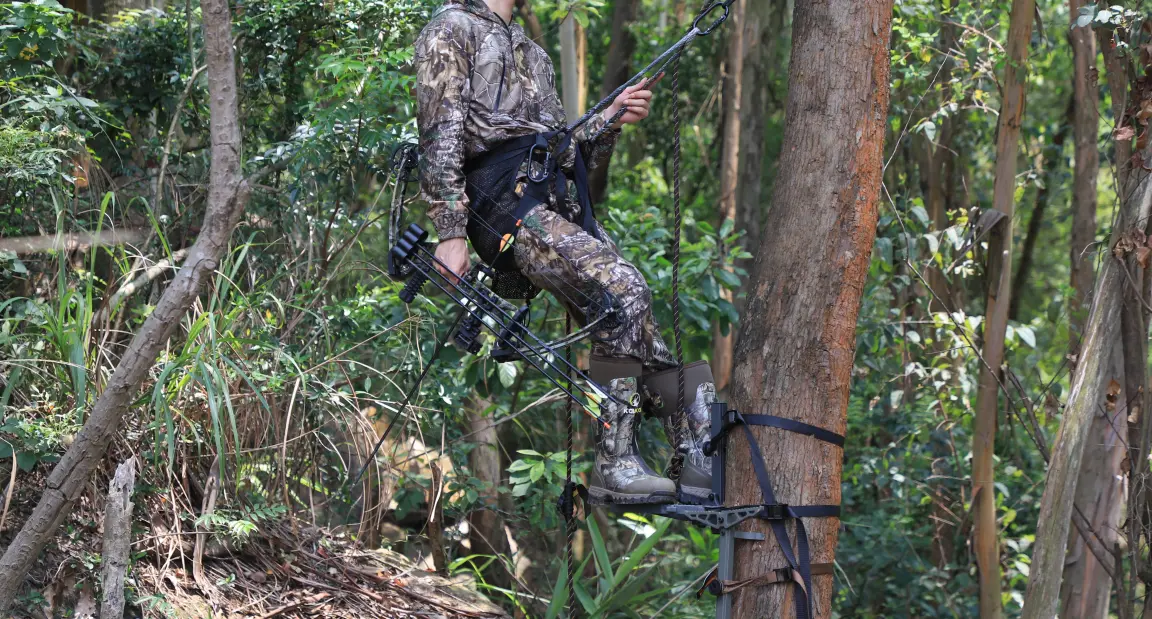
Know Your Shooting Lanes Before the Deer Shows Up
Once you are seated in the saddle, you’ll need to survey the area in every direction on the ground to determine the exact openings in the terrain that will allow arrows or bullets to pass cleanly.
Take note of each opening specifically, such as the opening between the two saplings at fifteen yards or the open space where the trail intersects the old logging road at twenty-two yards.
For each opening, figure out how you need to position yourself to be comfortable. For example, if you have identified one opening directly in front of you, you may call it ‘Opening A’ and find that it doesn’t require any movement.
If another lane is located thirty degrees off center to the left, this could be called ‘Opening B,’ and you would likely need to rotate your upper body slightly to draw a bead on it.
What to Do When the Deer Shows Up
What do you do when you watch a doe trot down a trail in the direction of your saddle?
Short answer, and it may surprise you: nothing.
The last thing you’ll want to do is rush yourself and create movement by bringing up your rifle or bow. Resist that impulse. Instead, take a few moments to breathe and slow your heart rate down a bit, and then watch the deer and see where it’s headed.
How fast is it traveling? Is it alone? Is there something larger moving behind it? This will be critical information regarding strategy and timing, and it can be gained without causing the deer to feel threatened.
And from there, slowly raise your weapon and wait for the best shot opportunity. The most common error made by new hunters is that they fire their arrow or rifle at the very first opportunity that’s presented rather than waiting for the optimal opportunity.
For instance, if a deer is walking along a narrow trail but it’s toward a wider opening, you should wait to shoot when it steps into the opening rather than when you first spot it on the trail.
Mistakes That Cost Saddle Hunters Their Shots
Some of the biggest mistakes that saddle hunters can make include:
Picking a Tree Based on Climability
Picking the tree based on how easily you can climb it (rather than what the best vantage point would be) is a big mistake that hunters often make.
The easiest trees to get into can generally be the worst for spotting deer because they have straight trunks with little opportunity to hide behind them. And more importantly, they’re also usually oriented directly opposite from where deer are going!
Here’s the fix: determine your hunting position, and then go look for the best climbing tree in that general area (even if it’s less aesthetically pleasing).
Setting Up on the Wrong Side
Another mistake is setting up your stand facing the “open” side that deer will come through from. Even though this may seem like the right thing to do, what this really means is that it will be easier for the deer to spot you.
Again, the fix is to identify the direction the deer will travel before you climb, and then situate yourself in such a way that as the deer approach they do so from the blind side of you, ultimately ending up in your open firing arc.
Forgetting to Check Your Shot Path
The last common mistake is to not check your bullet or arrow arc. You don’t want to discover mid-draw, for instance, that you’ve got a branch in front of you that’s going to potentially impede your arrow flight path.
The simple fix is to check this during your initial setup process. Do this every time. No exceptions.
What Actually Works Out There
It all comes down to this: don’t expect to feel natural and confident in your position in the saddle immediately when you start your first season. You won’t.
Because as soon as you start hunting from a ladder stand system, you’ll quickly discover that working out the kinks that are associated with positioning yourself will take some time.
However, once you’ve worked those kinks out, things will rapidly improve. Your initial few sits may require making numerous small adjustments and questioning whether you are doing everything correctly.
The only way to know if you are, again, is to test your saddle thoroughly before the day of the hunt.
Conclusion
A hunter who has his or her saddle hung in a suitable place with the geometry worked out like we’ve discussed above and who is holding perfectly still can become nearly invisible to deer.
But staying in that saddle for long periods will require you to be patient. Deer hunting from a saddle is easy in concept. As you can hopefully tell by now, when it comes to practice, it takes a lot more effort.
If you’re still deciding whether saddle hunting is right for you, see our guide to the pros and cons of saddle hunting before getting started.