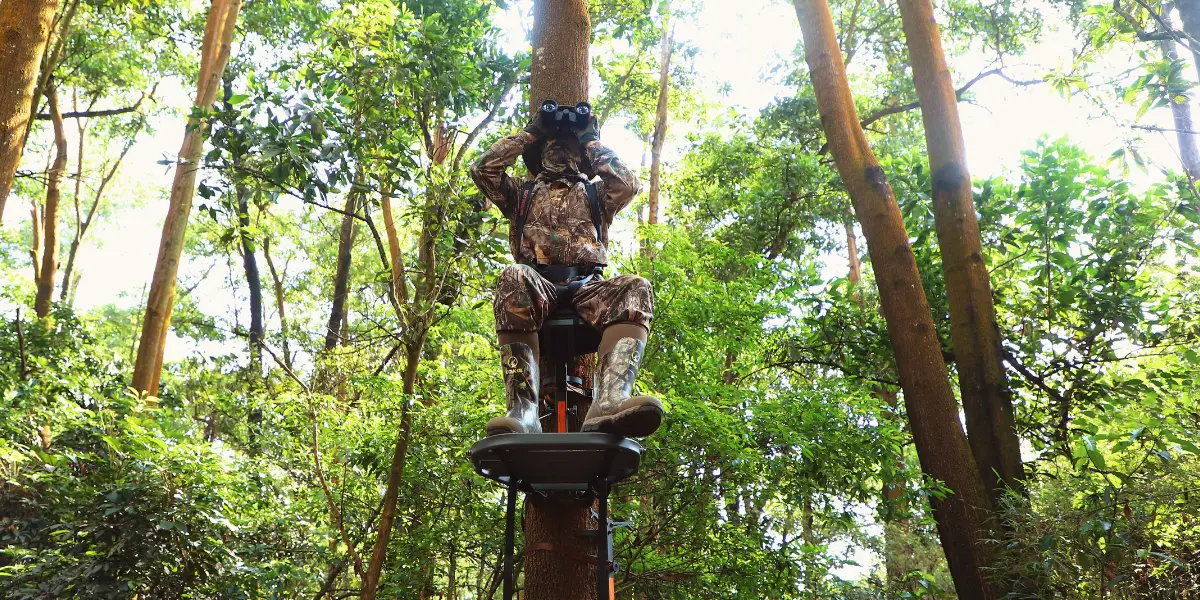
At some point, every deer hunter will hit the same crossroads: you’re browsing in an outdoor store aisle when you come across two options for deer stands right there in front of you.
One of the stands can fold into a pack and climb the trees like a caterpillar. The other stand includes a platform with a chair that needs to be dragged and then lashed onto a tree.
They both work, and they can both be used to kill deer. The actual question here is: which of these two deer stand types will best fit your actual method of hunting and your circumstances?
A fellow who’s hunting eighty acres of plant pines behind his house has many more issues than someone who drives two hours each way to hike one mile deep into a National Forest unit.
Let’s discuss how these deer stands will perform as you sit in the cold and darkness with deer grunting somewhere down the ridgeline.
Hang-On vs. Climbing Treestand Comparison
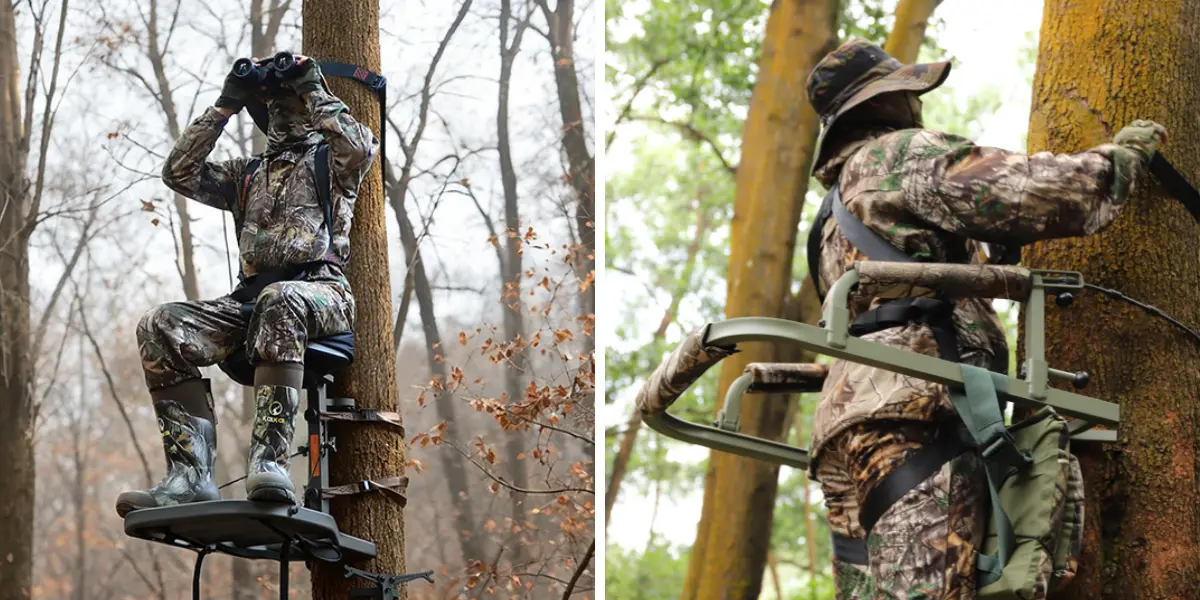
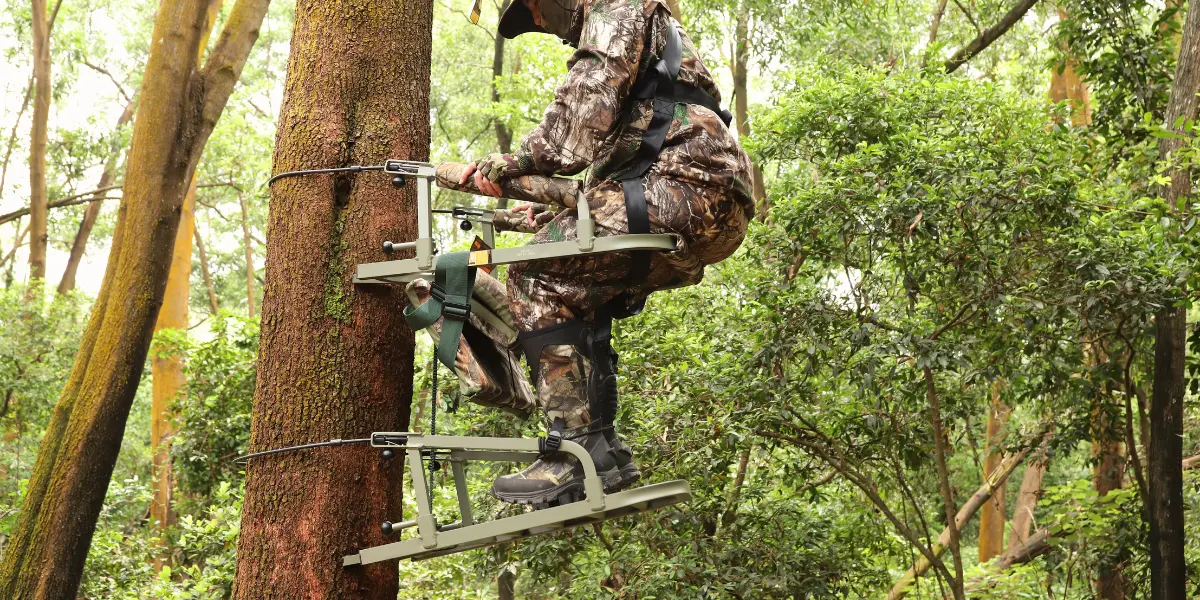
A climbing treestand system is made of two parts: the upper section (the seat) and the lower section (the foot platform).
Once you have wrapped the platform and the seat sections around the tree trunk, you’re ready to climb by sliding your body up using an “inchworm” motion. Basically, the two pieces are used together in an alternating motion to climb up a tree trunk.
These kinds of climbing treestand systems also come with a full-body safety harness and tethering device, which is designed to keep you held secure to the tree both during the climb and while you’re waiting for a deer to trot down the trail.
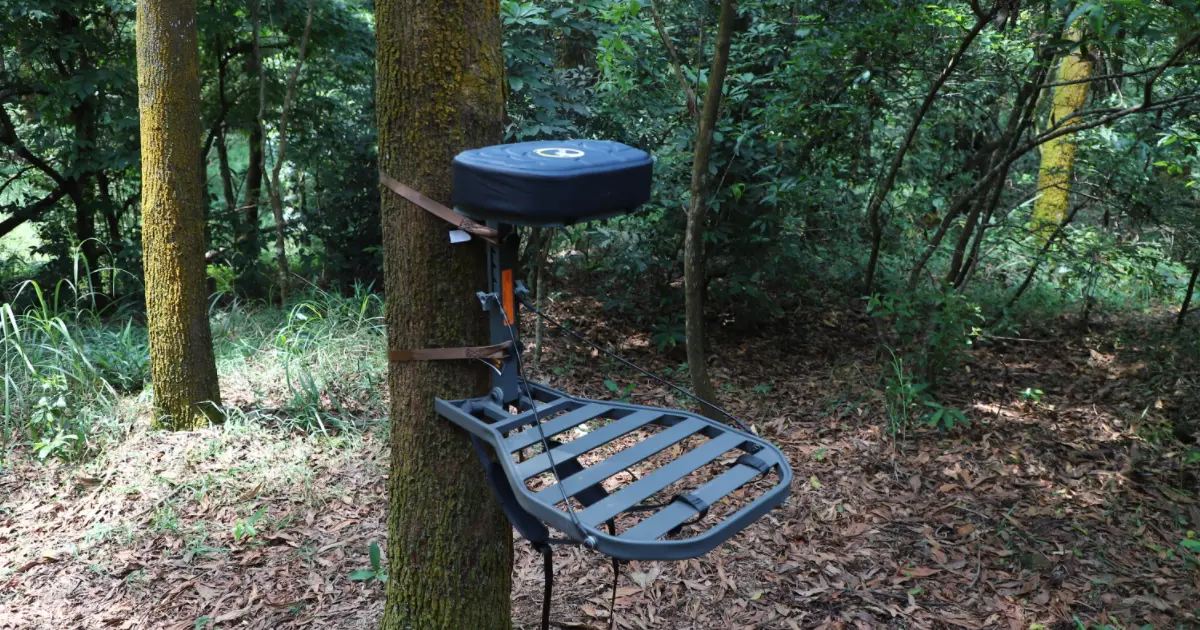
A hang-on treestand system, by contrast, consists only of the platform and the seat. There is no method of attaching the treestand to the tree in such a way as to help you climb it like a climbing treestand. Instead, you’ll need to use a ladder stick setup or climbing sticks to get up to the stand.
Quick Comparison Table
| Factor | Hang-On Treestand | Climbing Treestand |
| Weight to carry | Lighter stand, but requires separate climbing sticks or steps | Heavier as a single unit, but no extra sticks needed |
| Setup speed | Slower. Sticks go up one at a time; stand is strapped on separately | Faster. Climb and hunt in one continuous motion |
| Noise while setting up | Quieter overall | Metal-on-bark contact can be noticeable, especially on cold mornings |
| Tree requirements | Works on almost any tree, crooked or branchy | Needs a straight, relatively branch-free trunk of consistent diameter |
| Best hunting style | Fixed spots hunted repeatedly through the season | Mobile hunters who relocate based on fresh sign |
| Public vs. private land | Better for private land where a stand can stay put | Better for public land, pack in, pack out, no trace left behind |
| Learning curve | Easier for beginners to use safely | Takes more practice to climb smoothly and safely |
| Price range | Typically lower cost per stand | Typically higher cost, all-in-one unit |
What Factors Matter For Your Hunting Stand Choice?
There are four factors that will outweigh everything else when you’re deciding on either climbing treestands or ladder stands:
What Kind of Trees You’re Hunting In
This is probably the biggest reason why people who buy their first ladder-style treestand online skip the details.
The tree you attach a stand to doesn’t have to be perfectly round, but the diameter of the trunk should remain fairly consistent for the entire length; otherwise, when you climb higher, the platform will slant (which is an obvious safety hazard).
Trees that make climbing easier include Poplar and Straight Pines. Sweet Gum, Tulip Poplar, Young Maples, and Cottonwood. Trees that are growing near plantations or large-scale timber production areas will also provide excellent opportunities.
Trees that make climbing difficult? Mature White Oaks and Shagbark Hickory are two of the most common culprits.
Mature White Oaks in particular create a natural dilemma; they often grow in deer-friendly areas (deer like eating the acorns that White Oaks produce), but they are also impossible for a climber to use due to their size, shape, and branches.
How Mobile Do You Need to Be
Mobility is not just weight; it’s weight plus the time that’s needed to set up (and how much noise you make while doing so!).
Climbing tree stands are sold as a one-piece unit. They’re heavier as a single piece, usually around 15 to 25 lbs, so they will be somewhat heavier to carry into a hunting location by themselves.
But once you get them set up, you’re done because they allow you to climb the tree without any additional tools needed.
Hang-on treestands, as we went over above, require additional tools for you to get up the tree (like with climbing sticks). Normally you will ned to carry 3 – 4 climbing sticks to reach the desirable height. Or if you are experienced enough, you can try the one-stick hunting method.
So even though a climbing tree stand may weigh more by itself, hang-on setups will require you to bring in more items, which could add up to even more weight.
Hunters who hang a stand in September and continue to hunt in the same spot through January don’t require mobility, so hang-ons are ideal for scenarios like this.
However, hunters who need to relocate on a regular basis (as in every week or even multiple times per week) will need to think differently. Climbers perform best for these kinds of hunters because they are genuinely faster (and easier) to set up.
How Important Are Concealment and Placement
A climber gets you the tree it will accept, but it may not be the tree that you want. This is because the climber has to grip and slide up the trunk itself, and so it only works on trees that actually fit the narrow requirements of the climbing device itself.
The tree has to have roughly the same diameter from top-to-bottom, and without any branches in the way.
A hang-on, by contrast, doesn’t have to climb anything. The sticks do the climbing, and they only need enough bark to strap onto. This is why they’ll go up a crooked trunk, a forked trunk, or one with limbs every three feet.
Where Do You Hunt?
Private ground will usually favor the hang-on, for the simple reason that you can hang two or three stands in the off-season, trim or remove branches from your shooting lanes, and then walk in clean all year.
Public grounds can be messier. The fact that there are often rules against overnight stands (not to mention possible theft) should push you toward a climber.
Which Treestand Is Right For Your Hunting Style?
Now it’s time to stop hedging and give some straight answers!
When a Hang-On Is the Better Choice
You should use a hang-on when you’re hunting in hardwoods (especially forests with oaks or hickories) and when you will have permanent access to the property and can set up blind sites before the season begins.
A hang-on is also a better choice for when concealment is a top priority, and you need to stay close to deer bedding sites.
Here’s a hypothetical example:
Let’s say that you’re hunting during peak rut phase on a hardwood ridge where two small creek drainages meet, and where the only tree with a clear view of each trail is an old double-trunked oak with branches at about eight feet off the ground.
Climbers would never make it there. A hang-on with four sticks would get you twenty feet up in the fork so you can cover both trails. That’s all the argument that ever needs to be made for using a hang-on.
When a Climbing Treestand Is the Better Choice
Go with a climber for hunting in pine forests, in managed timber areas, or in river bottom poplar areas. A climber is also a good idea if you’re going to be relocating all the time and need to have an easy-to-grab piece of gear.
Let’s say it’s the opening day of a rifle hunt on top of a pine hillside over a cut-over. The deer could enter from any of the three sides of this cut-over area, but you’re just not sure which.
A climber that sits twenty-two feet above the ground with an unobstructed view of the open space across two hundred yards will be just what you need.
A Third Option Worth Knowing About
If none of these descriptions fit you, then look at tree saddles. A hunting saddle is basically an apparatus that allows the hunter to suspend from the side of a tree using a small step-platform or series of rings rather than sit in a full stand.
Saddles are very lightweight and can be used on nearly every type of tree (regardless of whether the tree has branches), and they also fold up small enough to fit inside a backpack.
The disadvantages of saddles are that they require a major learning curve, as well as a seating arrangement that may appeal to one hunter while being uncomfortable to another.
If you fall into the latter category, there’s nothing wrong with sticking with a hang-on or a climbing treestand.
Don’t Forget the Safety Setup
To begin with, none of this matters if someone gets injured, and treestand injuries put many hunters in the hospital annually, more than almost any other type of injury in the woods.
There’s no debate over what should be part of your non-negotiables when you’re hunting from a climber stand or a fixed stand. These include:
- A full body harness that’s properly worn every time you go into the treestand.
- Lineman’s belts that will allow you to connect to the tree when climbing up and down.
- Climbing sticks for quick climbing.
- Lifelines or tethers that keep you attached from the minute you leave the ground until the minute you get back down.
- A haul line so you don’t have to carry everything up manually.
Before you get into the stand, examine every strap and cable for frays, cracks, and signs of rot. The sun deteriorates webbing much faster than most people recognize. Inspect every bolt and pin, and put enough weight on the platform before entering to test its stability.
▶Learn more about: How To Use a Safety Harness for Tree Stand Hunting?
FAQs About Hunting Treestands
Is a hang-on or climbing treestand better for public land?
A hang-on with climbing sticks is generally better for public land areas since it goes up almost any tree (crooked, limby, oddly sized, you name it), whereas a climber needs a straight trunk with no branches for the first 20 feet. This can be a genuinely hard find in lands with unmanaged timber.
Can you use a hang-on treestand without climbing sticks?
You can choose from various options such as using screw-in ladder systems where allowed by local authorities, strap-on ladders, or even using a single long-handled tool that will be stepped upon in a “leap-frog” type manner.
But if there is no hanging system (or anything else) that allows you to climb up to the hang-on, then it’s simply a flat metal plate sitting on the ground. The only way to get up is via a system; it cannot be added later as a separate item.
Do climbing treestands work on any tree?
No. The main thing that climbers require is a tree with a straight trunk and no branches. Trees that have peeling bark (like hickory), trees with a lot of taper in their trunks, and trees with significant leans to them won’t be suitable for climbers.
Are climbing treestands safer than hang-on stands?
Climbing stands and hanging on are both just as risky. One isn’t inherently more or less safe than the other, and you’ll want to take identical precautions with both.
Which is easier for a beginner, a hang-on or climber?
A climber, generally, but only in the right timber. There are fewer components, one continuous process, and less to go wrong. A beginner in oak country, though, will have a frustrating time with a climber and may be better served learning a hang-on setup properly from the start.
Which is better for bowhunting, a hang-on or climber?
A hang-on is best most of the time. Bowhunting requires you to get up close and be in just the right position, and being able to select the specific tree that has both adequate cover and an adequate shooting lane is worth something when the shot is twenty yards.
When the trees will allow it, climbers can work well for bow hunting. However, when compared to the climber, the hang-on is going to give you more options.
Can you leave a climbing treestand in the woods?
Yes, physically you can leave a climber attached to a tree for an extended time. However, leaving a climber on a tree for an extended period of time is, well, also largely impractical. The weather will degrade the straps and cables over time, for one thing. There’s also a high risk of theft when using a climber as a permanent fixture in public areas.
Conclusion
Do you shoot in straight-up timber frequently and pack all your equipment each night? You’ll likely need a climber. Or are you shooting in hardwoods and want to have your hunting area prepped prior to sitting? A hang-on is probably the better bet.
Regardless of what’s attached to your back, just make sure that you’re wearing the harness, checking the straps, and practicing using it in complete darkness before the morning of the hunt.