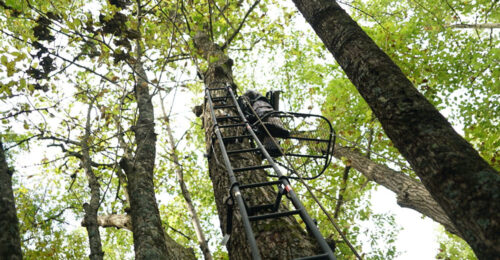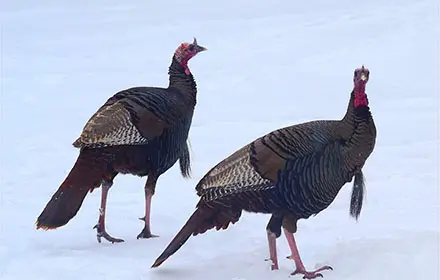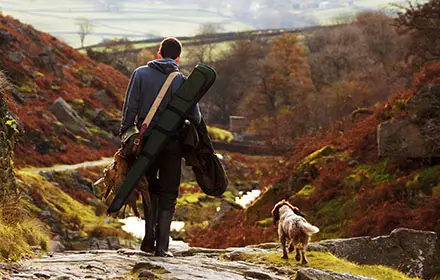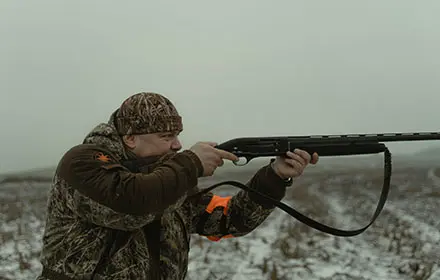
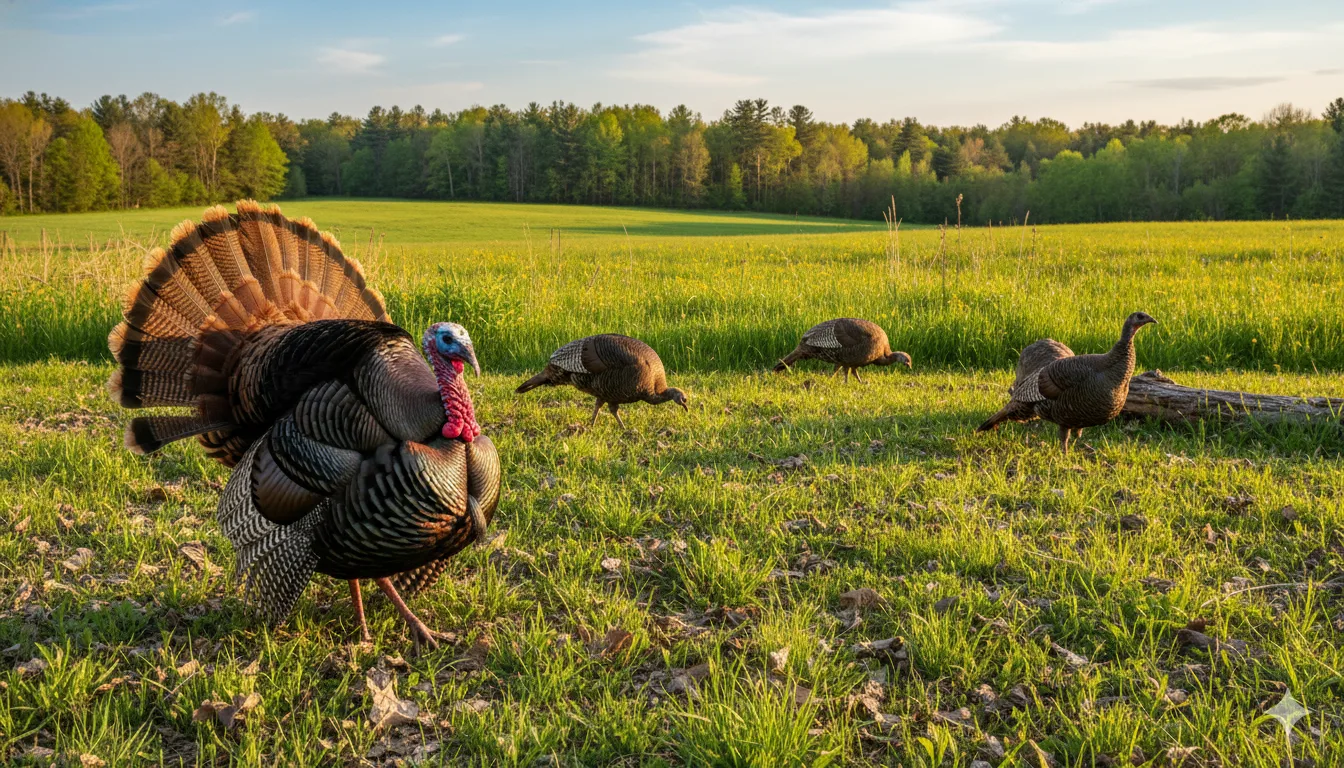
The landscape is usually really quiet (especially on a spring morning) in the woodlands of North Idaho about twenty minutes prior to actual shooting hours.
It was very early in the day. The world outside was cool, humid, and everything was still frozen.
This is how my successful turkey hunting story begins.
Setting the Scene
I hunted last year in northern Idaho’s Kootenai County. It was in a section of National Forest, just south of Lake Coeur D’Alene.
If you’ve ever spent any amount of time in the woods up there near the big lake, you’ll probably get an idea of what type of terrain I’m describing: mixed conifers, some large fir stands, a few abandoned logging roads covered in brush, and several creek bottom areas where water-loving birds will go during rain or cold snaps.
The date of our turkey hunt was the second week of May. My hunting buddy that day was Cole. He’d been hunting turkeys longer than I was, and he was much more patient at it than I was and still am.
Our local forecast indicated it would be around 40 degrees Fahrenheit at dawn. It was a little bit windy as well, and we saw that there could be rain showers coming through that afternoon, so we were ready with warm hunting clothes (more on this below).
Before the Hunt
The area I hunted had already taken a week of scouting before the hunt. I have always relied on driving forest roads early and late to listen for birds.
In addition, I also use the onX app to identify all the old logging decks, food plots, and meadow edges that I can visually find by using satellite images on the app.
This particular tom’s gobble had been audible to me off of the forest road on three different days. Each day, he would be roosting in an area of large fir trees over a small creek bottom that opens up into a grassy bench.
This bench was the most important feature. Toms love to “strut” or display themselves in open areas where hens may see them, and this small half acre clearing was possibly the best strutting spot I’ve seen.
One evening at last light, I had walked into the woods and sat on a log about 300 yards away from his roost. As he flew up, he let out two loud gobbles on the limb, and then he went quiet for the remainder of the night.
So far, no pressure. No other hunters seemed to know anything about this rooster either (other than Cole).
The Morning of the Hunt
Cole and I pulled out of his Dodge Ram at around 4:45 A.M. It was just under a mile by walking distance to get to our area, but the bulk of this walk was uphill along an older skidder road.
The reason for the early arrival was to have time to set up well before “fly-down” occurred. I’ve found that the one thing that’s most certain to bump a roosted bird is to arrive too late!
We walked slowly and quietly. Each of us was wearing a red headlamp, and we didn’t say anything. Just as we were about halfway into the walk, the unmistakable and haunting screech of an owl called out from a small ridgeline to the north of us, which caused my stomach to tense up.
A tom will many times make a loud gobble when he sees or hears someone below him at first light. However, our bird remained silent; this could be a positive indicator (he was still sleeping), or negative (he’d already made a move).
We continued walking to the location where we were going to set up. At approximately 5:20 A.M., we arrived at our designated setup site.
On a prior scouting trip, I selected the base of a large fir tree that was located 80 yards downwind of the strutting bench. This location provided an excellent view of the strut-bench, and it also allowed for a clean shot line to the entrance of the clearing.
Cole positioned himself about ten yards behind me to serve as a caller. While neither of us is particularly proficient callers, I knew that if there was a tom roosting nearby, he would focus past me and onto Cole due to his position directly behind me. Cole has an advantage in calling because of his better skills.
Additionally, by positioning the caller behind the shooter, it allows the shooter to shoot the bird while it is focused on committing itself to the shooting lane.
Two decoys were placed in front of me, a hen feeder and a half-strutted jake decoy. Each decoy was placed approximately ten yards ahead of me. Both decoys were oriented at slightly less than ninety degrees to my left so that an approaching tom would enter my field-of-fire from my right-front side.
By forcing the approaching tom to choose a direction for entry, I thought it would provide the best opportunity for a broadside or quartering-toe shot when entering my shooting lane.
Things Go Sideways…
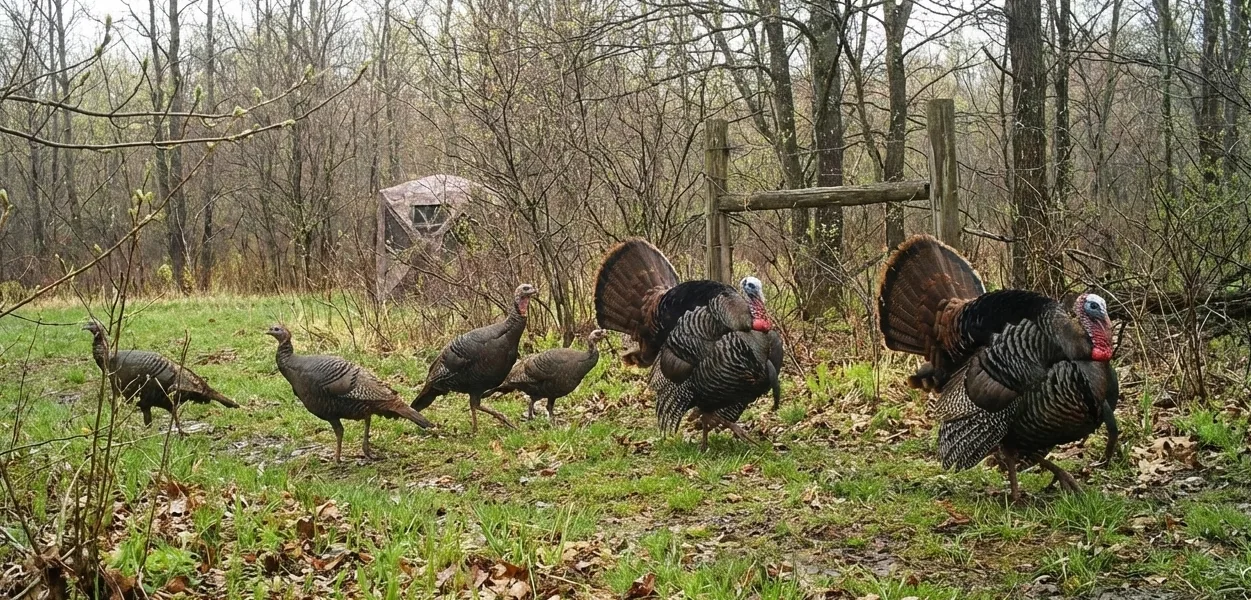
At about 5:50 A.M., one of the hens began yelling at me from her perch. Shortly thereafter, our tom let out a very large and long gobble, and I could feel the electric excitement of turkey hunting.
He was in the perfect position!
However, it would soon become apparent that things would quickly begin to unravel. Cole used a soft “tree” yelp on his slate call, and the tom responded loudly. Things seemed fine so far. A few minutes went by, and we heard wing-flapping sounds as the hens flew down to meet the tom.
Shortly after, the tom himself took flight. However, rather than landing softly in the bench area, the tom sailed directly over us and landed approximately 200 yards beyond our position in an open clearing. As he landed, he let out a long string of gobbles.
But now things were rapidly deteriorating. Wind direction was now unfavorable for moving behind the tom and his hens, and neither Cole nor I could get close enough to utilize our decoy setup.
We exchanged a knowing glance, shrugged silently (as many hunters are accustomed to doing), and thought about our next course of action.
I then made three strong, aggressive calls. The first call included some serious “cutting”. The tom gobbled almost instantly after each call. Although the tom was clearly interested in what I had to ‘say’, he was still committed to joining his ladies.
I made another call, which was even more aggressive than the previous call and honestly bordering on being obnoxious. The tom gobbled again, but he was still clearly not going to make the trip over to us.
I stopped calling altogether and went completely silent for approximately twenty minutes.
This is where the magic happened. I’ve noticed over the years that when a tom becomes fixated with a group of hens and you continue to call, you generally drive them further away.
They believe that the hen they have been listening to will come to join them, and once she does not show up, they simply remain with the hens they already have.
When you stop calling, however, it piques their curiosity. It also allows the real hens to lose interest and begin wandering off.
The Shooting Approach
At about 7:15 A.M., I heard a gobble from much closer. Maybe a hundred yards behind us, and to the right. He’d circled.
I gave one soft cluck on my mouth call, the kind of sound that a hen makes when she’s contentedly feeding, and he hammered back from about sixty yards.
I slowly turned my body to face the direction the gobbles were coming from. My shotgun was already up on my knee, finger off the trigger but ready. I could feel my pulse in my ears.
He came into view at about forty yards, slipping through the timber like a shadow. Full strut, white head glowing in the gray morning light, fanned out and looking for the hen he’d been hearing.
He saw the decoys and froze. I held my breath.
He gobbled again, and then he dropped out of strut and started walking stiff-legged toward the jake decoy, clearly intending to whip him. He closed to twenty-five yards, twenty, then fifteen.
When he was about twelve yards from the jake, he came out of the strut again, stretched his neck up to gobble, and I squeezed the trigger.
Essential Gear to Use
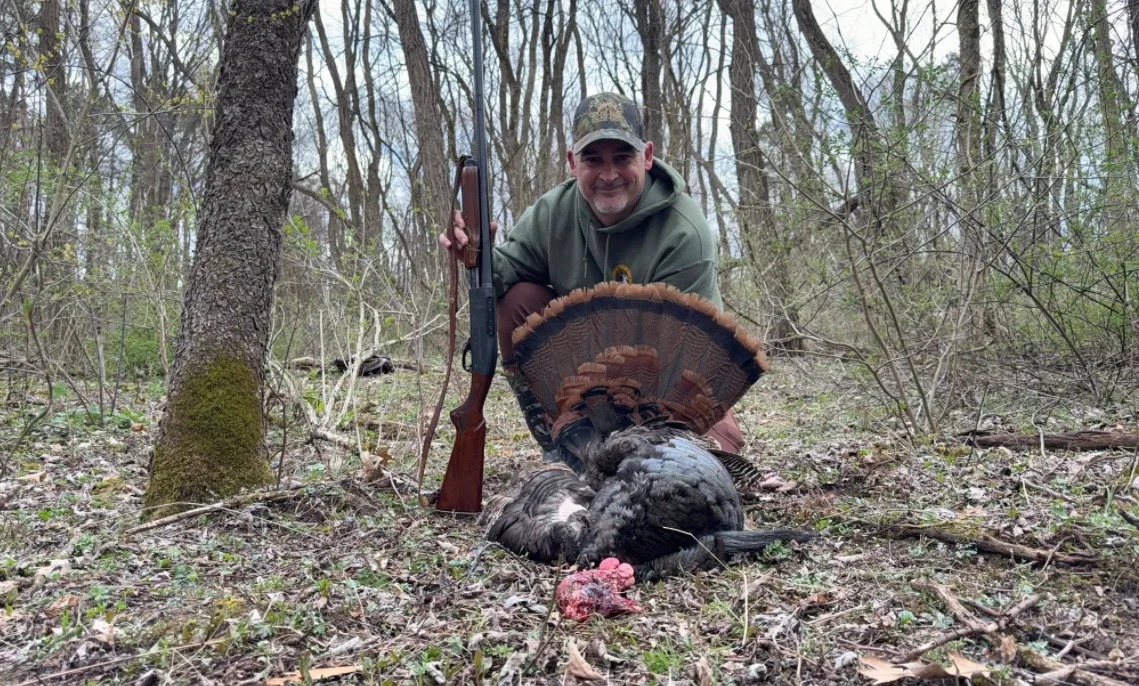
I was running my Mossberg 500 12-gauge that morning. It’s a workhorse of a shotgun with classic wood furniture, the kind of gun that looks like it should be hanging over a fireplace in a hunting lodge.
I have two barrels for it: a 28-inch barrel that I use for hunting, and an 18.5-inch barrel that stays at home for defense. The longer barrel patterns turkey loads beautifully with a tight choke, and I was shooting three-inch Winchester Long Beard XR number fives.
Cole was using a Slate Call from Woodhaven, while I had a Primos Mouth Call for making turkey calls. I wore Sitka OptiFade Subalpine camouflage gear, as there are many dark green conifers in the area where we hunt in northern Idaho.
I also wore my Crispi Nevada GTX boots as the ground was still damp, and I wanted to avoid being uncomfortable by 8 A.M.
In addition to these items, I also brought along my turkey vest, a small thermos of warm coffee, and my decoy birds.
What I’d Tell Other Hunters
If you’re hunting public land in northern Idaho, especially around Kootenai County, here’s what I’ve learned.
First, use your ears (not your camera) while scouting. Take a drive through the roads early in the morning with the windows rolled down and listen.
Second, pass by those areas that all other hunters are going to. The pull-over that most people will stop at is probably the last area you should take your birds.
Third, get as close as you can to where they roosted the night before, but instead of sitting right next to it, sit approximately 100 yards farther away.
Fourth, if a turkey hangs up (and therefore does not continue moving), sometimes the loudest thing you can do is nothing.
Wild turkey hunting is primarily based upon reading the behavior of turkeys rather than trying to dominate or “out-shout” them. The next morning, after leaving the forest, I was carrying a twenty-two-pound wild turkey across my shoulders.
The two-inch-long spurs were hanging below his feet, and I had learned a valuable lesson that has stuck with me throughout many subsequent hunts: at times, the best call you ever made is the one you never called!
—Hunting story contributed by Hunter Nicholas O.