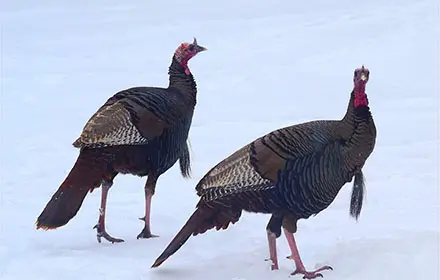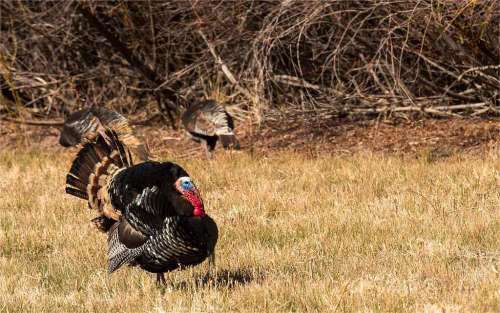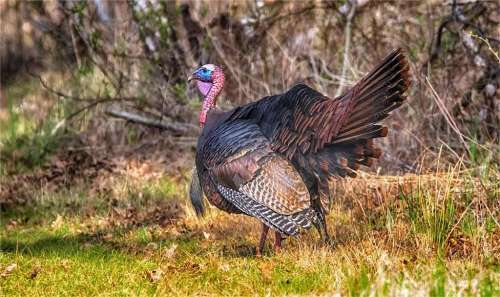
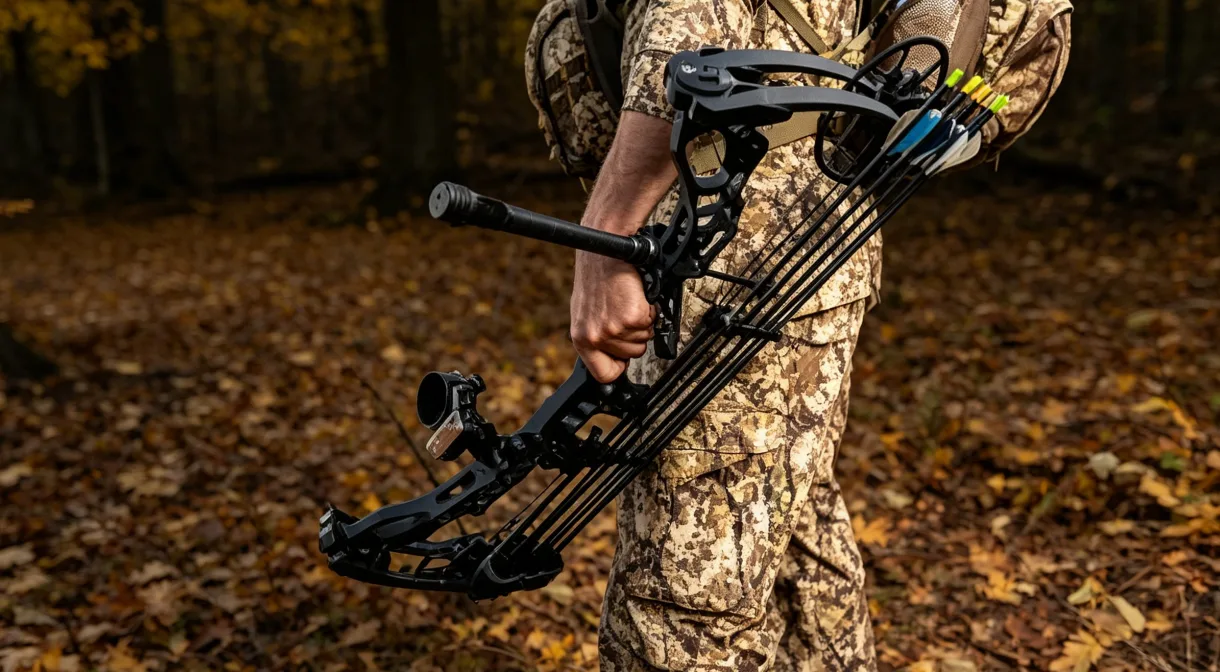
There’s a reason most turkey hunters reach for a shotgun: a bird’s eyesight is sharp enough to spot a twitchy eyebrow at forty yards, and drawing a bow on a strutting tom feels a little like trying to thread a needle while standing on a trampoline!
But if you can pull it off, there’s nothing else quite like it.
Here we’ll cover some crucial tips for hunting turkeys with a bow. These tips will include understanding the different behaviors of your target turkey, how to set up your decoys, what kind of shot you should take, and the common mistakes many people make that keep them from bagging their first gobbler.
Read Turkey Behavior Before You Draw
Turkeys have their own daily routine. This is important to know when hunting them with archery equipment.
Each night after sundown, turkeys will go to a tree to roost. The next morning, as soon as the sun comes up, they will drop out of the trees and begin their day.
In the early morning, they will eat and strut around while searching for females. About mid-morning, the hens will leave to build nests, and the males will search for some female companionship.
After this, all activity appears to slow, and they seem to be getting ready to head back to their roosting areas for the evening.
The reason mornings work better than later in the day is that the turkeys follow a daily routine. The male turkey has an idea about where he would like to end up once his feet touch the ground.
If you’ve been doing your scouting, you should have an idea as well. When the bird leaves the roost, he’s on a mission to find a spot to scratch.
Once the birds arrive at their destination, if they were successfully scouted, they can be shot. As these same birds move throughout the day, they become less focused on being in one particular location.
It may take some time to locate the bird again; this could be a mile or two away from where the bird was located earlier in the day. Most successful bow hunts occur during the first three hours of daylight.
That is when things really get interesting. Although there is no guarantee that things will go according to plan, even when you follow each step correctly, turkeys always seem to be able to ruin your plans.
There are three things that consistently cause problems when hunting turkey:
The Hang-Up
A tom will gobble his head off, run to about sixty yards, stop, and continue to gobble. He waits for the hen to find him since this is what was established by nature.
Either you remain completely silent (in some cases, birds become driven mad by complete silence), or you create scratching sounds on the ground with your feet and make soft purring noises as well as clucking sounds to appear like a hen searching for food at an extreme distance from where she began.
Aggressive calling can also end the standoff, especially if you are close enough to a real hen so that you can challenge her.
The Circle
When some of those tom turkeys show up, they will often circle away, sliding into your downwind position and/or hooking their way to come at your decoy at an angle…which will put your shot window in a difficult location.
The reason this occurs is that the turkey wants to take a look at what made all the noise before it decides to commit to coming in. Your setup can affect how successful you are with this type of hunting.
Try to set up your decoys in such a manner that you can make sure that when a circling bird comes in, it’s within shooting distance. Also, make sure that you have something wide enough behind you to help conceal your profile if that bird circles around to get behind you.
The Silent Approach
This one might give you a heart attack: you call, but there’s no response.
You begin to feel as if the woods themselves have died, and then you glance upward and see a turkey more than thirty yards away staring back at you!
When tom’s are under pressure (i.e. during hunting season), when there is actual hen presence nearby that you don’t want to scare off, and/or when a more dominant bird has taken residence, they become silent.
In short, this means you need to remain vigilant even when it seems like nothing is going on. Move slowly and frequently scan your surroundings. Don’t pack up simply because the woods were quiet.
▶Read more: We Went Silent on a Hung-Up Gobbler, and It Worked.
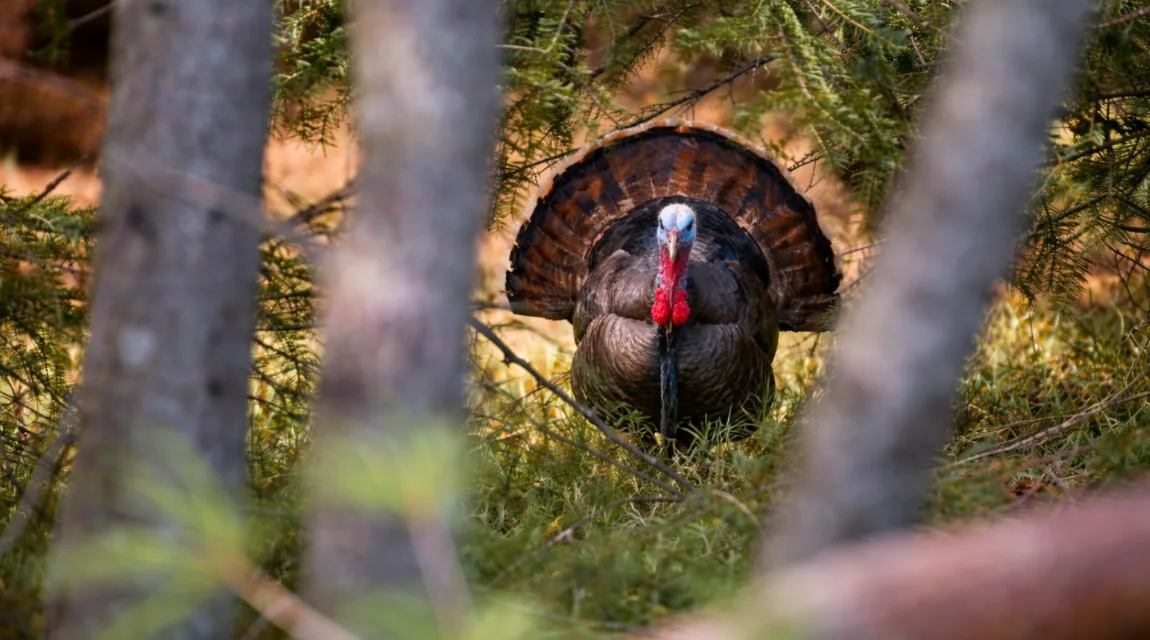
Adjust Decoy Setup and Calling Strategy for Bow Range
A key factor to consider with a bow (versus a shotgun) is the required decoy placement.
For example, shotgunners may place a decoy out at 20 to 25 yards and still have an acceptable amount of space for error, whereas bow hunters require that decoy to be placed within an 8 to 10 yard radius.
This is because when a tom comes to a hen decoy, the tom will typically post up at a certain distance from the hen (usually 5 to 6 yards) and then begin “strutting” in front of her.
If you are placing your jake or hen decoy out at 20 yards, the tom will likely be at 25 yards as well. In contrast, by placing your decoy at 10 yards, the tom will be at 15 yards.
This represents a major difference between having a clean shot and watching another opportunity pass.
Use a Jake-and-Hen Decoy Setup
Many bow hunters employ both a “strut” tom/jake decoy along with one or two hens positioned very close to each other.
By doing this, you can create a scenario in which a real gobbler will become angry regarding the perceived encroachment of another gobbler upon his female companion. And once the tom becomes enraged, he will charge into position quickly.
Place your Jake so that the approaching tom will face directly toward your blind. When he reaches a point where he is ready to defend his hen from the perceived intruder, he will turn and present himself in a broadside position. It’s at this exact moment that you should take your shot.
Ground Blinds Help Hide Movement
Using a ground blind will greatly aid in concealing your motion while drawing as well. Taking a shot while exposed in an open field is nearly impossible.
Even though many people think otherwise, birds tend to be oblivious to the appearance of a newly created blind in their environment.
As such, they will often approach a pop-up blind without hesitation. Simply brush some foliage around your blind to provide additional concealment if you have time available before the birds arrive.
Tone Down Calling Once the Bird Commits
In regard to calling, there are instances where calling too loudly or too often can actually scare off a bird that is committed to finding the hen decoys.
Many bow hunters prefer mouth calls because they allow hands-free operation while staying ready to draw. When calling to get an aggressive tom fired up, be as loud and boisterous as possible at first.
However, once you know the tom is headed in your direction, tone down your calling significantly. Use soft purring, clucking sounds, and the occasional loud “yelp”.
Avoid over-calling once the tom is within shooting range (30 yards) since you don’t want to spook a bird that is almost in shooting position.
Understand Effective Range and Shot Placement
Recommended Shooting Range
Most bowhunters think they have much better turkey range than they do. You may be able to hit a bullseye (or something close) at 50 yards, shooting an arrow into a target from your backyard, but hitting a living turkey is far tougher.
Here are the issues:
Your arrow needs to hit the small vitals of a turkey, the bird is rarely going to stop moving (and hitting a moving target is always more difficult), and when you shoot a turkey at long ranges, there is ample time for it to notice the string on the bow, and duck, jump, or turn around.
This reaction to the string is called “jumping the string,” and turkeys are infamous for doing so.
In reality, the ideal archery hunting range for wild turkeys is between 15 to 25 yards. If you are hunting within 15 yards with the most common setups, you will likely get results.
From 30 yards, if you know what you are doing and the bird is relaxed. Beyond 30 yards, you’re taking a shot in the dark.
Where to Shoot The Turkey
There are some big differences in how bowhunters shoot turkeys compared to shotgunners.
Shotgunners typically try to get as many pellets as possible on the turkey’s head and neck because there is such a high chance that some of those pellets will penetrate the brain and kill the turkey.
For a bowhunter, however, shooting at a turkey’s head is extremely difficult. The head is very small and constantly moving, and if a bowhunter misses his target completely, he may have no idea where the arrow even went!
In order to increase the chances of killing the turkey quickly and cleanly, a bowhunter should aim at the turkey’s body rather than its head.
Where to place the arrow depends on how the turkey is positioned.
When the turkey is broadside (the side of its body facing him), the best place to shoot the turkey is near where the front leg meets the body and slightly to the left of center. The path of the arrow will allow it to pass through both the turkey’s heart and lungs, thus providing instant death.
Many bowhunters choose to take what is referred to as the “wing butt” shot; this is when an arrow is placed so that it passes up through the breastbone and creates a wide wound that goes into vital organs.
When a turkey is positioned so that it is looking directly at the bowhunter, the bowhunter should position his arrow at the base of the turkey’s beard.
An arrow shot at this location will destroy most of the vital organs immediately upon entering the turkey, and most turkeys that have been shot in this manner fall dead instantly.
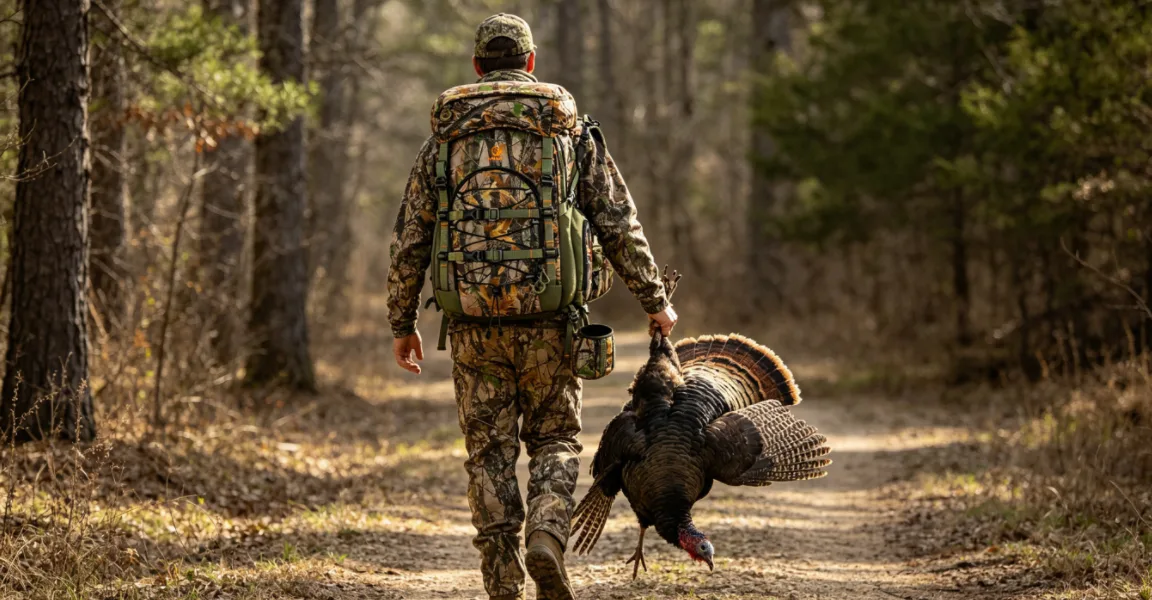
When to Shoot, When to Wait, and When to Walk Away
Wait for the Right Shot Angle
The hardest aspect of turkey hunting with a bow isn’t taking the shot; it’s determining if you should take the shot.
You need to shoot when the turkey is stationary (not moving), broadside (facing directly toward you), or turned so as to be looking directly at you or your blind. The only other criterion is that the turkey needs to be within your effective shooting distance.
Additionally, don’t shoot the turkey unless it is not visually scanning you or your blind area. Ideally, you want to wait until after a strutting tom stops strutting and takes a few seconds to scan its surroundings and gobble.
Watch for Tom to Pause
At this point, the tom will likely freeze for approximately two to three seconds while it stretches its neck. This is typically your best opportunity to take the shot.
Wait for the turkey to start walking and strutting again with his fan obstructing the path to the turkey. The waiting game can be particularly grueling since your arm(s) are usually shaking due to drawing back your bowstring.
But make no mistake, a rush of adrenaline that’s caused by trying to shoot too quickly at 28 yards will prove to be far worse than a shot fired calmly at 15 yards!
If you cannot maintain your drawn position anymore, just allow the string to slowly drop down, and then re-draw your string once the tom has turned his head.
Don’t Rush the Shot
Lastly, walk away from the location if you continue to spend more than thirty minutes waiting for the turkey to commit itself to a particular area and does not appear willing to do so.
Occasionally, the most intelligent decision is to retreat from the original area, travel approximately a quarter mile or so in either direction, and then attempt to call from a new angle.
While a tom may refuse to enter an area previously attempted, he may well run into said area from a completely different angle.
Common Mistakes Bowhunters Make
A few patterns show up over and over with new bowhunters. Watch for these:
Drawing too early
People see a tom at forty yards coming in and pull the bow back, planning to hold until he’s at twenty. Twenty seconds later, their arms are jelly, the bird hangs up at thirty-five, and the shot falls apart.
Wait until he’s committed and close, or use a blind so you can draw inside it without being seen.
Aiming for the head
Old habit from shotgun hunting. Don’t do it. The body is the target with a bow.
Skipping the blind
A blind isn’t required, but it triples your odds. Drawing a bow on an open ground setup with a turkey at twenty yards is a clinic in heartbreak. Use the blind.
Calling too much when the bird is close
Once he’s committed, shut up. Real hens don’t yelp every fifteen seconds at a tom standing ten yards away. They give a soft cluck or just feed quietly.
Underestimating practice
Backyard practice in a T-shirt is not the same as kneeling in a cramped blind with a heart rate of one-forty wearing a heavy jacket.
Practice from the actual positions you’ll shoot from, in your actual hunting gear, until the shot feels automatic. Get a Kalkal archery target for practicing and improving your skills.
Conclusion
Turkeys are a lot harder to get close to with a bow than they are with a shotgun. The window of time to make a mistake simply gets smaller, as well as how tight you can set up the area.
That being said, I like the challenge! There is no feeling quite like getting within ten yards of a tom, having him break stride to gobble at you, and then putting an arrow straight through his chest. This experience will stick with you forever.
If you can read the turkey, set up your decoys properly, know exactly your effective range, and be patient and wait for the tom to do something stupid… well, there is little doubt that he will.