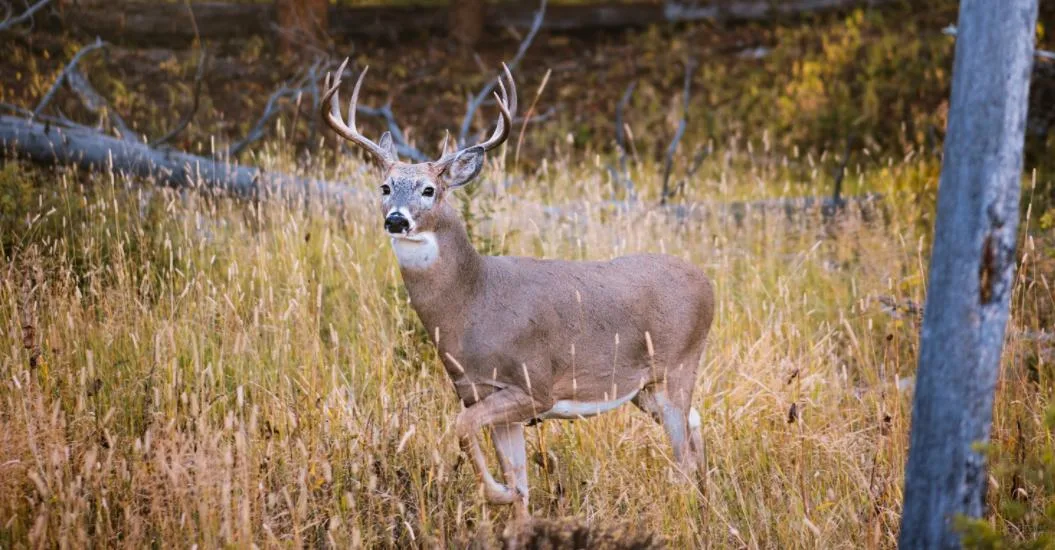
It may seem impossible to determine when a mature buck is going to appear. That is where the 7-day rule comes into play: if you get a daylight photo or sighting of a mature buck on a given date, he often shows up in the same area during that same 7-day window in later years.
The rule was named and described by Dan Cole, a record-book measurer with 25 years of experience, in North American Whitetail.
Many veteran hunters use this rule to plan their hunts around that one week instead of spreading their effort across the whole season.
In this guide you will learn what the rule actually says, how to find your buck’s window from trail camera dates, how to test it on your own property, and why it sometimes fails. We also separate what research supports from what is hunter lore.
What is The 7 Day Rule For Bucks?
The 7-day deer rule is a hunting strategy based on the idea that mature bucks often return to the same spots in the same 7-day window year after year. These spots include scrapes, food sources, or bedding areas.
Here is how it works in practice. Say you get a daylight photo of a mature buck on November 5. Treat November 5 as the center of a 7-day window, November 2 through November 8.
The rule suggests that in later seasons, that same buck is likely to travel the same area during that same window, sometimes at nearly the same time of day.
Cole’s examples include a buck taken a year and a day after he was first seen in the same spot, and a Mississippi non-typical killed within 100 yards of where it had been seen a year earlier.
Those are individual stories, not a controlled study, which is why we treat the rule as a planning tool you test yourself.
The rule is built around mature bucks. Young bucks are poor candidates: in Mississippi State University’s research, up to 80 percent of yearling bucks left their mother’s home area.
Is It 7 Days After the First Photo, or the Same Week Next Year?
The version published in North American Whitetail is the annual one: the same 7-day window, year after year. Some hunters also use “7 days” to mean a buck coming back a week after a photo.
Neither study cited in this guide tests that weekly version, and Mississippi State’s GPS data show bucks rotating through several focal areas within hours.
Treat a weekly return as something to check with your own cameras, not as a given.
How Does It Work?
The pattern comes from two things: the rut runs on a fixed calendar, and a buck that feels safe keeps using the same food, travel routes, and bedding.
Once a buck feels secure in a location, he may actually return to the same location on a regular basis to feed, check scrapes, or scent-mark territory. Those visits matter most during the pre-rut and rut seasons, when buck movement rises.
The research that best explains the logic comes from the Mississippi State University Deer Lab, which tracked adult bucks with GPS collars. It found that bucks do not return to a single sanctuary.
They use many focal areas, and 74 percent of the collared bucks changed focal areas every 6 to 10 hours. One buck used 10 focal areas in a single week during the rut.
That is why a 7-day window is a window, not an appointment: the buck is rotating through several spots, and your camera covers only one of them.
The study ran on private land in Mississippi, where peak rut falls between December 25 and January 7, so your dates will differ.
What the Research Supports (and What It Doesn’t)
Two findings support the ideas the rule depends on.
A buck’s travel pattern during the pre-rut and rut is heavily driven by testosterone levels and photoperiod (the amount of daylight).
- According to research highlighted by the National Deer Association, bucks of every age moved more as the rut peak approached. In that University of Wisconsin–Madison and Wisconsin DNR study of 188 GPS-collared bucks (2017 to 2020), movement peaked around November 4 to 8 each year. The date of the year predicted buck movement better than anything else the researchers measured, and the rut peaked on the same days regardless of weather, moon phase, or hunting pressure.
- Some bucks come back to the same place on similar dates. In the Mississippi State study, about one-third of adult bucks were “mobile,” holding two seasonal home ranges about 4 miles apart on average, and bucks tracked for two years switched between them at very similar times each year. Its authors advise noting when a buck first starts using your property, because next year he will likely be there about the same date.
Neither finding proves a buck will walk past your stand on a given day. Together they explain why a dated photo is a useful clue for next season.
They also found no link between buck movement and moon phase (Mississippi State) or temperature swings (Wisconsin), which is why this guide builds the window from dates, not from weather or moon charts.
How To Find The 7-Day Window?
The 7-day deer rule sounds simple, but finding your deer’s specific window takes effort and data. Here’s how to identify and use this pattern effectively.
1. Use Trail Cameras to Identify Patterns
It is most appropriate to begin by installing trail cameras in probable areas of deer. Place them on travel routes between bedding and food, on scrape lines, and at field edges.
Adult bucks use food plots mostly at night, so the corridor between cover and food often gives better daylight photos than the plot itself.
Once the same mature buck shows up on dates that fall inside the same 7-day window across two or more seasons, that is your possible pattern.
Keep cameras running every season and keep every photo with the date and time stamp on. Years of dated photos are what show whether a buck repeats his window or shifts with the rut, food, or pressure.
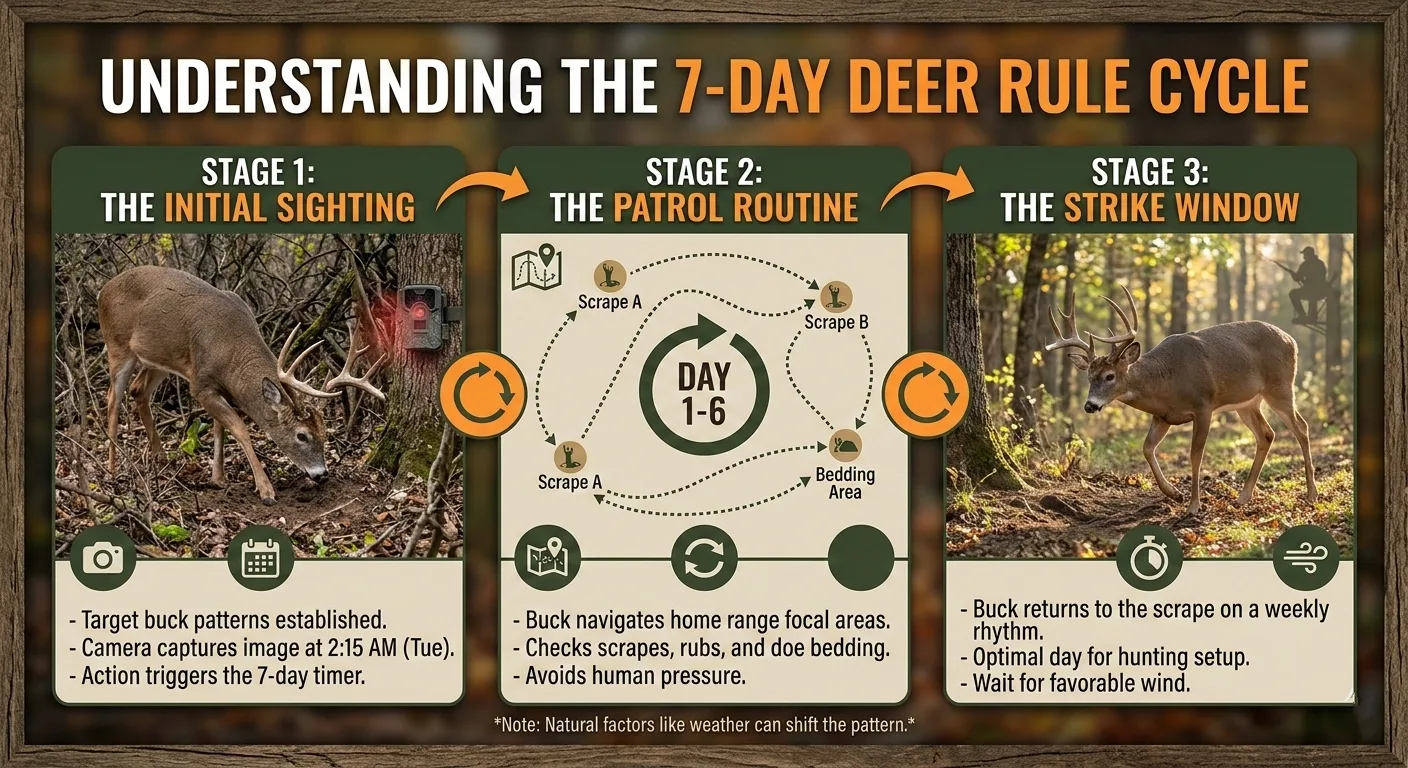
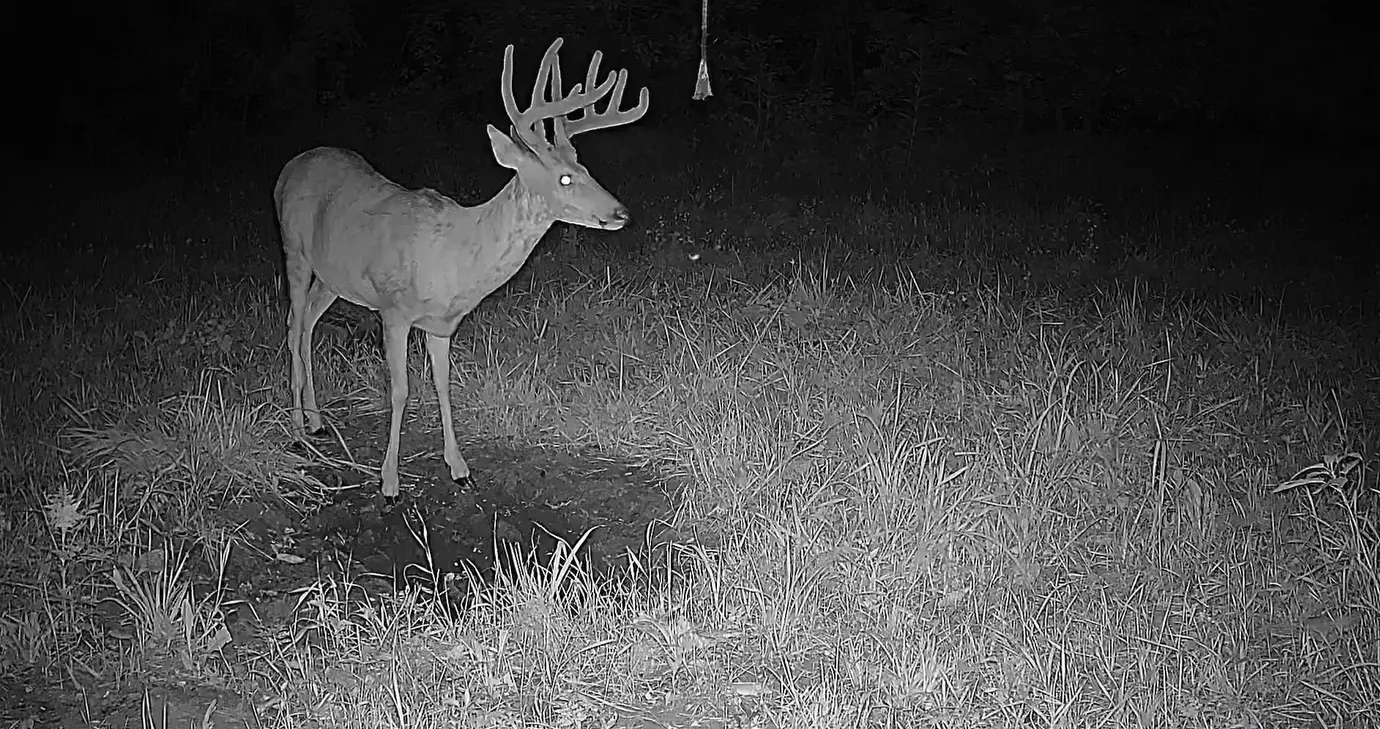
To understand how strict this schedule can be, consider a field test: a mature 10-pointer showed up on a scrape camera at 2:15 AM on a Tuesday. Instead of overhunting the stand the next day and leaving human scent, we waited.
Exactly one week later, on the following Tuesday, a cold front dropped the temperature by 15 degrees. We slipped into the stand that afternoon, and true to the 7-day rule, the same buck appeared at 4:30 PM, working the exact same trail.
2. Find Typical Locations Where Deer Appear
It is also important to know the way deer prefer to move as well. Such places are usually funnels, rub lines, scrapes, and field edges.
You can find them by walking around your property or studying topographical maps. Deer like to move in natural cover such as tree cover or creek cover.
When you find fresh drops, tracks, or mock scrapes, put your camera there. These are the places mature bucks tend to revisit.
3. Know the Key Factors Behind the Pattern
Several environmental and biological factors affect how consistent the 7-day rule will be.
- Rut Period: Bucks travel the most during the rut, but at peak rut they chase does and can leave their usual routes. The rut’s calendar is steady from year to year, which is what makes dated photos useful.
- Scrapes and Rubs: These are focal points in the weeks leading up to peak rut, which makes them good camera spots.
- Food Sources: Deer follow dependable food sources like acorns, cornfields, or clover plots.
- Pressure: If hunters disturb the area, deer may change their timing or move elsewhere.
By combining these factors with camera data, you can improve your odds of being in the right place when your target buck returns.
4. Analyze Past Data
You have already been running cameras for several seasons, and you have some valuable information. Go back and see when certain bucks came out every year.
You will often find that the same bucks, having grown to maturity, will recur in the same locality during or about the same week of the year.
One reason is that the rut is tied to the calendar: the Wisconsin study found the rut peaked on the same days in each of four years, regardless of weather, moon phase, or hunting pressure.
With enough seasons of data, you can build a dependable history for each buck and pick your best days well before the season opens.
How to Test the 7 Day Rule in Your Location?
The 7-day rule is not certain to work all the time. It is relative to your local area, the deer density, and the level of pressure. Nevertheless, it is easy to test as long as you have a systematic process.
Step 1: Gather Data with Multiple Cameras
Install at least three to four trail cameras in various areas within your hunting property. Put them on travel routes, scrape lines, and field edges, and keep your visits to a minimum. Turn on the date and time stamp and set the cameras to trigger on motion.
Run them for at least one full season; two or three seasons is better. The idea is to record the dates and times mature bucks pass each location.
Step 2: Log and Compare Activity Dates
Write a logbook or an Excel spreadsheet to track the photo times and dates. Emphasize repeat visits by the same buck.
When the same buck shows up inside the same 7-day window in more than one season, you have probably found his window.
One match can be a coincidence, so wait for a second or third. Log the date, time, camera location, wind, and temperature for every photo, plus a note on how old you think the buck is.
Step 3: Test the Theory
Now comes the fun part. Hunt inside the anticipated window. As an example, if a buck was photographed on November 8 last year, plan your sits for November 5 through 11 this year.
Get up early in your stand and keep on the alert during the time period he comes into view. Researchers found bucks move throughout the day, and leaving the stand after two or three hours means missing opportunities.
The buck can appear a few hours earlier or later sometimes.
Repeating the test at different sites over several seasons will show you whether the 7-day rule really applies to your property.
To test the weekly version (a buck returning about a week after a photo), use the same logbook and look for repeat visits spaced six to eight days apart. Treat a few repeats as a hint, not proof.
Step 4: Use Tools to Refine Your Predictions
Modern hunting tools make testing the rule even easier.
Use a hunting app such as HuntStand or onX to mark your camera and stand locations, check the wind for each stand, and note sunrise and sunset times.
Weather and moon data are worth logging, but treat them cautiously: the Mississippi State study found no relationship between moon phase and buck movement, and the Wisconsin study found no significant effect from temperature.
Use dates to set the window and wind to choose the stand.
Step 5: Keep Notes for Multiple Seasons
Consistency is key.
Test the 7-day theory over several hunting seasons, and check your state’s season dates so your window falls inside a legal hunting period.
If your observations align year after year, you can lean on the pattern when you plan hunts.
When Does The 7-Day Rule Work Best?
The 7-day rule shines under certain conditions. Knowing these can help you decide when to trust the pattern and when to adjust your strategy.
- During the Early and Pre-Rut Periods: Bucks are still predictable and focused on feeding areas and territory marking. A window that lands in peak rut is still worth hunting, since buck movement is highest then, but expect him to cover more ground.
- In Low-Pressure Areas: Deer stick to patterns when they feel safe. Private lands or remote zones often show stronger 7-day consistency.
- Stable Weather Conditions: Wind, food, and hunting pressure that stay similar from year to year help a buck keep his routine. Temperature swings alone did not change buck movement in the Wisconsin study.
- Consistent Food and Water Sources: If your property has a reliable acorn drop or food plot, deer movements become more rhythmic.
- Mature Bucks: The rule is built around mature bucks. A young buck may disperse or change ranges.
What Are Some Reasons The 7-Day Rule May Fail?
Like any theory, the 7-day rule isn’t foolproof. Several factors can break the pattern and throw your predictions off.
- Human Disturbance: Frequent visits to check cameras or scent contamination can spook deer, causing them to alter routes.
- Weather Shifts: Hunters report that heavy rain or high wind can delay a buck’s movement on a given day. Research has not shown temperature swings shifting the rut itself.
- Breeding Season Distractions: During peak rut, bucks may abandon their normal routes entirely to chase does.
- Food Source Changes: If crops are harvested or acorns stop dropping, deer will move to new feeding areas.
- Predator or Hunting Pressure: Increased coyote activity or nearby hunters can make deer go nocturnal or relocate.
- A Mobile Buck: About a third of adult bucks in the Mississippi State study held two seasonal home ranges. A mobile buck can disappear from your property for months and then reappear, so a missing buck is not always a dead or spooked buck.
- The Buck Didn’t Survive: In the same study, annual survival for adult bucks ran 60 to 75 percent, with hunter harvest the leading cause of death, so some of your best candidates will not be back.
Your 7-Day Rule Implementation Checklist
Before you head into the woods, follow these exact steps to capitalize on the 7-day window:
- Log the Initial Sighting: Record the exact date, time, and weather conditions when a target buck appears on your camera.
- Mark the Calendar: Next season, highlight the three days before and the three days after that date. This is your strike zone.
- Check the Wind: Never hunt the spot on any day in your window if the wind direction is wrong for your stand. If the wind favors the deer’s nose, wait for a better day.
- Stay Out Until the Window: Skip unnecessary trips to the spot and to your cameras beforehand, since hunting pressure can move a buck within days.
Frequently Asked Questions
What Exactly Is the 7-Day Rule for Deer Hunting?
The 7-day rule is a hunting theory that suggests a mature buck may travel the same area during the same 7-day window each year. Hunters use it to predict possible movement from a dated trail camera photo or sighting, then plan their sits for that same week in later seasons.
Is the 7-Day Rule Backed by Science?
It rests on hunter observations and on related research: the rut peaks on the same dates each year in a given area, bucks use multiple focal areas, and some bucks return to a property on similar dates each year. Deer often develop repeatable habits related to feeding, bedding, travel routes, and seasonal behavior, although the timing can change due to pressure, weather, and other factors.
How Do I Pick the Right 7-Day Window?
Start by reviewing trail camera data to identify when a specific buck is active in an area. Record the date and conditions, then plan your hunt for the same week next season, three days on either side of that date. Adjust your plan based on weather, hunting pressure, food sources, and other conditions.
Is the 7-Day Rule Reliable for Both Private Land and Public Land?
The 7-day pattern is often easier to identify on private land because deer typically experience less hunting pressure. On public land, increased human activity can change deer behavior and movement patterns, making weekly patterns less predictable.
What If the Buck Showed Up During a Different Week This Year?
That can happen. Changes in food availability, hunting pressure, or the buck’s own home range can shift his movement from year to year, while the rut calendar itself moves very little. Look for similar conditions around the new sighting date and focus on overall seasonal patterns rather than relying on an exact schedule.
How Many Years of Data Do I Need to Trust the Pattern?
Two or three seasons of consistent trail camera data can help reveal useful patterns, but more years of observation usually provide better confidence. Long-term tracking helps determine whether the same buck or other deer are following similar movement patterns in the area.
Is the 7-Day Rule a Week After the First Photo or the Same Week Next Year?
The published rule is the same week next year. A weekly return after a photo is a separate idea that is not backed by the research cited here, so test it with your own logbook.
Do Moon Phase or Cold Fronts Change the 7-Day Window?
In the research cited here, no. Mississippi State’s GPS study found no pattern tied to moon phase, and the Wisconsin study found temperature did not play a significant role. Use dates to set the window, then adjust for wind and pressure.
Conclusion
The 7-day rule for deer hunting gives you a way to turn dated trail camera photos into a short list of days to hunt. It’s not a guaranteed formula, but it’s a practical way to narrow down the best days to hunt a mature buck.
By logging trail camera dates, studying travel routes, and tracking wind and pressure, you can uncover your deer’s personal schedule.
Once you understand the rhythm of your local herd, you’ll waste less time guessing and more time hunting smart.
For more aspects of hunting deer, check out our Complete Deer Hunting Guide. If you plan to hunt a buck’s window from a different tree each time, see our Hang-On vs. Climbing Treestand, and our guide to finding the best ground blind location.
Sources:
- Mississippi State University Extension: Understanding Buck Movement
- National Deer Association: New Study Investigates Peak Rut Buck Movement
- North American Whitetail: The 7-Day Rule (Dan Cole)