
Colorado is a big state to hunt, and knowing the season dates is only the first step. Your species, weapon, GMU, and license type can all change what you can hunt and how you get a tag.
For 2026, there are a few important rule changes worth knowing before you head into the field. Such as, Colorado plans to replace the current hybrid draw structure with a new split system that gives half of the tags to the preference-point draw and half to a bonus-style random draw.
This guide covers the Colorado hunting seasons, license requirements, and costs, but it also looks at what these changes mean when you actually start planning a hunt. Because draw rules and hunt codes can change, always check the current Colorado Parks and Wildlife regulations for the specific hunt you plan to apply for.
Colorado Hunting Season 2026 Schedules
Colorado Hunting Seasons By Species
| Species | Zone / Area | Season / Type | Date |
|---|---|---|---|
| Deer | Statewide | Archery | Sep 2–30, 2026 |
| Deer | Statewide | Muzzleloader | Sep 12–20, 2026 |
| Deer | Statewide | Rifle – First Season | Oct 14–18, 2026 |
| Deer | Statewide | Rifle – Second Season | Oct 24–Nov 1, 2026 |
| Deer | Statewide | Rifle – Third Season | Nov 7–15, 2026 |
| Deer | Statewide | Rifle – Fourth Season | Nov 18–22, 2026 |
| Deer | Plains | Rifle | Oct 24–Nov 3, 2026 |
| Elk | Statewide | Archery | Sep 2–30, 2026 |
| Elk | Statewide | Muzzleloader | Sep 12–20, 2026 |
| Elk | Statewide | Rifle – First Season | Oct 14–18, 2026 |
| Elk | Statewide | Rifle – Second Season | Oct 24–Nov 1, 2026 |
| Elk | Statewide | Rifle – Third Season | Nov 7–15, 2026 |
| Elk | Statewide | Rifle – Fourth Season | Nov 18–22, 2026 |
| Moose | Statewide | Archery | Sep 12–30, 2026 |
| Moose | Statewide | Muzzleloader | Sep 12–20, 2026 |
| Moose | Statewide | Rifle (Antlered & Antlerless) | Oct 1–14, 2026 |
| Mountain Lion | Statewide | Regular Season | Nov 23, 2026–Mar 31, 2027 |
| Turkey | Statewide | Spring | Apr 11–May 30, 2026 |
| Turkey | Mountain Meadows Ranch | Spring Ranching for Wildlife (Residents Only) | Apr 22–May 31, 2026 |
| Turkey | Purgatoire Ranch | Spring Ranching for Wildlife (Residents Only) | Apr 11–20, 2026 |
| Turkey | Statewide | Fall | Sep 1–Oct 23, 2026 |
| Turkey | Statewide | Late Season | Dec 15, 2026–Jan 15, 2027 |
| Black Bear | Statewide | Archery | Sep 2–30, 2026 |
| Black Bear | Statewide | Muzzleloader | Sep 12–20, 2026 |
| Black Bear | Statewide | September Rifle | Sep 2–30, 2026 |
| Black Bear | Statewide | September Plains Rifle | Sep 2–Nov 22, 2026 |
| Black Bear | Statewide | Rifle | Oct 14–18, 2026 Oct 24–Nov 1, 2026 Nov 7–15, 2026 Nov 18–22, 2026 |
| Black Bear | Statewide | Private Land Only (PLO) | Sep 2–Nov 22, 2026 |
| Waterfowl | Central Flyway (Statewide) | Dark Goose – Regular Season | Nov 2, 2026–Feb 14, 2027 |
| Waterfowl | Central Flyway (Statewide) | Light Goose – Regular Season | Oct 31, 2026–Feb 14, 2027 |
| Waterfowl | East of I-25 | Light Goose Conservation Order | Feb 15–Apr 30, 2027 |
| Waterfowl | Jackson Co. (North Park) | Dark Goose | Oct 3, 2026–Jan 15, 2027 |
| Waterfowl | Jackson Co. (North Park) | Light Goose | Oct 31, 2026–Feb 14, 2027 |
| Waterfowl | San Luis Valley (Limited Counties) | Dark Goose | Oct 3–21, 2026 Nov 21, 2026–Feb 14, 2027 |
| Waterfowl | San Luis Valley (Limited Counties) | Light Goose | Oct 31, 2026–Feb 14, 2027 |
| Waterfowl | Chaffee, Custer, Fremont, Lake, Park & Teller Counties (South Park) | Dark Goose | Oct 3, 2026–Jan 15, 2027 |
| Waterfowl | Chaffee, Custer, Fremont, Lake, Park & Teller Counties (South Park) | Light Goose | Oct 31, 2026–Feb 14, 2027 |
| Waterfowl | West of the Continental Divide | Early Canada Goose (Pacific Flyway) | Sep 1–9 (each year) |
| Waterfowl | West of Continental Divide, Excl. Eastern Zone | Western Zone (Pacific Flyway) | Oct 3–11, 2026 Nov 6, 2026–Jan 31, 2027 |
| Waterfowl | Eastern Zone | Eastern Zone (Pacific Flyway) | Oct 3, 2026–Jan 6, 2027 |
| Migratory & Upland Birds | East of I-25 | Pheasant – Season 1 | Nov 14, 2026–Jan 31, 2027 |
| Migratory & Upland Birds | West of I-25 | Pheasant – Season 2 | Nov 14, 2026–Jan 3, 2027 |
| Migratory & Upland Birds | East of the Continental Divide | Sandhill Crane | Oct 3–Nov 29, 2026 |
| Migratory & Upland Birds | East of I-25 & South of I-70 | Quail (Northern Bobwhite, Scaled, Gambel’s) – Season 1 | Nov 14, 2026–Jan 31, 2027 |
| Migratory & Upland Birds | East of I-25, North of I-70 (I-25 East to Byers & Hwy 36 to Kansas) | Quail – Season 2 | Nov 14, 2026–Jan 3, 2027 |
| Migratory & Upland Birds | West of I-25 | Quail – Season 3 | Nov 14, 2026–Jan 3, 2027 |
| Migratory & Upland Birds | Rest Areas | White-Tailed Ptarmigan – Season 1 | Sep 12–Oct 4, 2026 |
| Migratory & Upland Birds | GMUs 44, 45, 53, 54, 66, 67, 68, 70, 71, 74–81, 444 & 751 | White-Tailed Ptarmigan – Season 2 | Sep 12–Nov 22, 2026 |
| Migratory & Upland Birds | Statewide | Rail (Sora & Virginia) | Sep 1–Nov 9 (each year) |
| Migratory & Upland Birds | Statewide | Wilson’s Snipe | Sep 1–Dec 16 (each year) |
| Migratory & Upland Birds | Statewide | Band-Tailed Pigeon | Sep 1–14 (each year) |
| Migratory & Upland Birds | Statewide | Dove (Eurasian Collared) | Year-round |
| Migratory & Upland Birds | Statewide | Chukar Partridge | Sep 1–Nov 30 (each year) |
| Migratory & Upland Birds | Statewide | Crow | Nov 1 – End of Feb (each year) |
| Migratory & Upland Birds | Statewide | European Starling & House (English) Sparrow | Year-round |
| Migratory & Upland Birds | Statewide | Dove (Mourning & White-Winged) | Sep 1–Nov 29 (each year) |
| Migratory & Upland Birds | Limited GMUs | Greater Prairie-Chicken | Oct 1–Jan 31 (each year) |
| Small Game | Statewide | Marmot | Aug 10–Oct 15 (each year) |
| Small Game | Statewide | Abert’s Squirrel | Nov 15–Jan 15 (each year) |
| Small Game | Statewide | Squirrel (Fox & Pine) | Oct 1–Feb 28 (each year) |
| Small Game | Statewide | Wyoming Ground Squirrel | Year-round |
| Small Game | Statewide | Rabbit (Cottontail, Snowshoe Hare & Jackrabbit) | Oct 1–Feb 28 (each year) |
| Small Game | Statewide | Coyote | Year-round |
| Small Game | Statewide | Prairie Dog | Jun 15–Feb 28 (each year) |
What’s Changing for Colorado Hunters in 2026?
Colorado’s 2026 hunting regulations bring a few changes that can directly affect how you plan a hunt.
The two biggest ones for many hunters are the new nonresident archery elk limits and expanded mandatory CWD testing.
Nonresident OTC Archery Elk Is More Limited
For 2026, nonresidents can no longer purchase OTC archery elk licenses for GMUs west of I-25 or for GMU 140.
Those hunts have moved to limited nonresident archery elk licenses that must be applied for through the draw.
Some OTC archery elk opportunities remain east of I-25. CPW lists specific hunt codes for these areas, so check the current Big Game Brochure before making your plans.
The change is mainly about controlling hunter numbers and crowding.
If you are planning an out-of-state archery elk hunt, check the GMU and hunt code first. Don’t book the trip based on an old OTC map or last year’s rules.
Mandatory CWD Testing Expands to Selected Elk Hunts
CWD testing is another change hunters need to pay attention to in 2026.
CPW requires hunters to submit CWD test samples from elk harvested during rifle seasons in specific hunt codes.
The testing is mandatory for those selected hunts, and there is no charge for the required testing. Not every hunt code within a GMU is included, so you need to check the specific hunt code rather than assuming the entire unit is covered.
For hunters in selected hunts, you’ll need to know where and how to submit the head for testing and plan for that before the hunt.
There is currently no mandatory CWD testing for harvested deer in Colorado’s 2026 season, although voluntary testing is available.
Colorado New Draw System: What Hunters Need to Know
If you’ve been building Colorado preference points for years, or are just starting out, you need to know the new draw changes for 2028.
The new system will apply to the primary draw for deer, elk, bear, pronghorn, and limited turkey licenses beginning with the 2028 draw. Colorado is moving away from the current hybrid system and replacing it with a 50/50 split draw.
A New 50/50 Split Draw
Under the new system, each hunt code’s primary-draw quota will be split into two halves:
50% goes to the preference-point draw. Hunters with more preference points have priority.
50% goes to a bonus draw. Hunters can have a chance even with zero points, while additional points give hunters more chances in the random drawing.
The old hybrid draw will be removed. So, Colorado is keeping a reward for hunters who have spent years building points while opening part of the draw to more hunters.
A hunter with 15 points won’t suddenly be treated the same as someone with zero points. But having 15 points also won’t mean that the entire quota is effectively reserved for high-point hunters.
Resident/Nonresident Split Changes
Starting in 2028, deer, elk, bear, pronghorn, and turkey hunt codes will use the same basic residency allocation: 75% for residents and 25% for nonresidents.
The old distinction between high-demand and low-demand hunt codes will go away. The allocation will also apply to first- and second-choice hunt codes in the primary draw.
For nonresidents, that means the popular units will no longer have the additional high-demand allocation restriction that could limit them to 20%. The 25% allocation still puts residents in the stronger position, but the system becomes more consistent from one hunt code to another.
Preference Points Changes
Colorado is also getting rid of the first-choice point-only hunt code for these species.
Starting in 2028, hunters can gain a preference point in two ways: purchase a point during the primary draw application period, or fail to draw their first-choice license and choose to receive a point.
There will also be a new fee for receiving a preference point for deer, elk, bear, pronghorn, or turkey:
- Residents: $15 per species
- Nonresidents: $30 per species
Hunters who don’t want to pay the fee can opt out and won’t receive the point.
| Colorado Big Game Draw Comparison: Current System vs. 2028 New System | |||
| Feature | Current System (Through 2027) | New System (2028) | Impact on Hunters |
| Tag Allocation Mechanism | 100% Pure Preference: All limited tags go strictly to applicants with the highest points. | 50% reserved for highest points, 50% entered into a weighted Bonus Draw. | Point thresholds for high-tier units will spike; zero- or low-point applicants gain a lottery chance at top units. |
| Resident vs. Non-Resident Quotas | 80/20 for high-demand units (>6 points); 65/35 for low-demand units. | Fixed 75% Resident / 25% Non-Resident across ALL limited hunt codes. | Non-resident tag quotas will drop across standard units; caps apply uniformly to 1st and 2nd choices. |
| Point-Only Applications | Enter point-only code as 1st choice while drawing tags on 2nd/3rd choices. | Must choose to either buy a point OR apply for a hunt license. | Forces a clear yearly application strategy. |
| Preference Point Fees | Points accrued via application fees with no dedicated point purchase tax. | $15/year for Residents, $30/year for Non-Residents per species. | Increases annual point-banking costs (up to $150/year for non-residents targeting all 5 main species). |
Colorado Hunting License Requirements and Costs
The costs vary depending on the type of hunting license, and some of them have increased a little from last year. Now let’s check how much it will cost you to hunt big game and small game in the state:
| License Types | Residents | Non-residents |
| Spring turkey(Adult) | $38.49 | $194.21 |
| Spring turkey(Youth) | $20.62 | $130.39 |
| Annual small game(Adult) | $38.49 | $104.86 |
| Small Game and Furbearer(Youth) | $2.53 | $2.53 |
| Furbearer-Only License | $38.49 | $104.86 |
| Veteran lifetime combo(Adult) | Free | / |
| First responder lifetime combo(Adult) | Free | / |
| Deer(Adult) | $51.25 | $506.92 |
| Deer(Youth) | $20.30 | $130.07 |
| Elk(Adult) | $70.40 | 845.16 (bull/fishing combo) |
| Elk(Youth) | $20.30 | 130.07 (youth/fishing combo) |
| Moose | $385.66 | $2,823.53 |
| Bear | $64.01 | $302.56 |
| Colorado Waterfowl Stamp | $12.76 | $12.76 |
| Federal Migratory Bird Hunting Stamp | $33.00 | $33.00 |
| 2026 Habitat Stamp | $12.76 | $12.76 |
How to Buy a Colorado Hunting License?
There are 3 ways to purchase a hunting license in Colorado. Here is how to do it:
- Purchase at a Retail Location: Check for hundreds of licensed retailers or a regional office and buy your license in person.
- Purchase by Phone: You can call 1-800-244-5613 to make a purchase.
- Purchase Online: Buy a license online or through Colorado’s official mobile app – ‘‘myColorado’’.
By following the above ways, you can easily get any hunting license at hand.
In addition to the hunting licenses, you may need some hunting stamps. Hunters between the ages of 18 and 64 are required to purchase a Habitat Stamp before obtaining a hunting license or applying for the drawing.
| Limited License Draw Application Processing Fee | $ 8.93 for residents |
| $ 11.49 for nonresidents | |
| Habitat Stamp | $ 12.76 |
| Lifetime Habitat Stamp | $ 384.16 |
When Is the Best Time to Hunt in Colorado?
For deer and elk hunters, September offers the classic early-season experience, while October and November bring cooler weather, rifle seasons, and increasing snow and animal movement.
September is the prime month for archery elk. The elk rut is getting underway, so bugling and calling can make for an exciting, close-range hunt. The downside is warmer weather, which means you need to take care of meat quickly after a harvest.
October is the main rifle-hunting window. The 1st Rifle Season is short and limited, while the 2nd Rifle Season provides a longer opportunity for deer and elk. Cooler temperatures can make meat care easier, but weather can start changing quickly in the mountains.
November brings tougher conditions but can offer good late-season opportunities. The 3rd and 4th Rifle Seasons occur later in the fall, when snow and colder temperatures can push deer and elk toward lower elevations and winter range.
It makes the hunt much harder, and hunters should be prepared for difficult mountain conditions.
Where Should You Hunt in Colorado?
Colorado has millions of acres of public hunting land.
Northwest Colorado is a strong option for elk hunters, particularly around the White River and Craig area.
The region is known for substantial elk populations and can appeal to hunters who care more about finding elk and filling the freezer than chasing a trophy in a highly sought-after unit.
Central Colorado offers a mix of National Forest and BLM land with varied terrain. It can be a good choice for hunters who want public-land opportunities but don’t necessarily want to commit to a deep backcountry hunt.
Southwest Colorado and the San Juan Mountains are better suited to experienced hunters who are comfortable with steep terrain and backpacking.
Areas around Gunnison, Ouray, and Durango offer classic high-country hunting, but the physical demands and access challenges can be significant.
For out-of-state hunters, pay particular attention to public access and private-land boundaries. Colorado’s public and private properties can be closely mixed, so having an offline map with property boundaries before you leave home can save a lot of trouble in the field.
The best Colorado hunting area isn’t necessarily the most famous unit. It’s the one where the tag, access, terrain, and season fit your hunting ability.
What to Expect When Hunting Colorado’s High Country?
Colorado hunting can be very different from hunting in lower-elevation states. Much of the popular big-game country sits at 8,000 feet or higher, and some areas reach well above 12,000 feet.
Altitude is one of the first things to prepare for. You may get tired much faster in the mountains. If possible, arrive a few days early and give your body time to adjust. Take it easy on the first day instead of planning your hardest hike right away.
Weather can change fast. A sunny morning can turn into rain or snow in a few hours, especially at higher elevations. Bring layers and be ready for large temperature changes even during early fall.
Finally, plan for the work after the shot. Elk and deer can be far from the nearest road, and getting meat back to your vehicle may take several trips.
Your physical condition and pack-out plan matter just as much as your hunting gear.
Essential Gear for a Colorado Hunt
You don’t need to bring everything you own into the mountains. Focus on gear that handles changing weather, long hikes, and rough terrain.
- Clothing: Use a layering system with a moisture-wicking base layer, a warm mid-layer, and a waterproof and windproof outer layer. This lets you adjust as temperatures change.
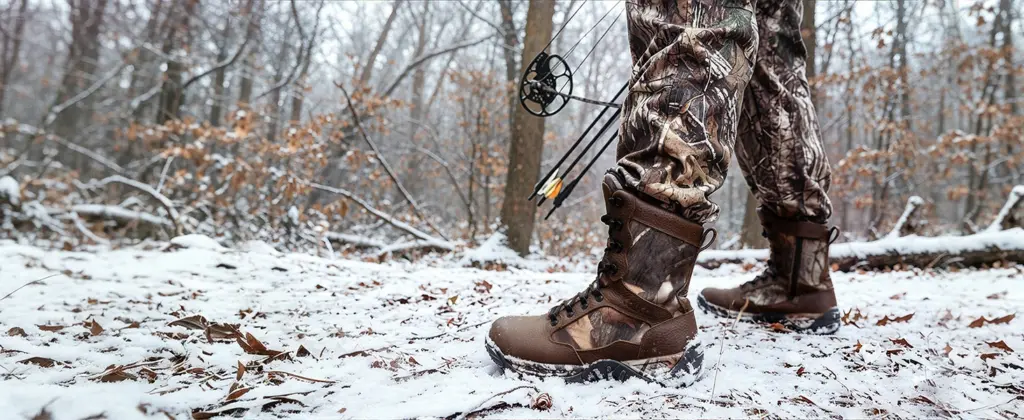
- Boots: Choose supportive hunting boots with good traction and enough waterproofing for wet ground and snow. A stiff, supportive sole is useful on steep and rocky terrain. Gaiters can also help keep snow, mud, and debris out of your boots.
- Optics: A good pair of 10×42 binoculars is useful for spotting animals across open slopes. A tripod can make long glassing sessions much easier. A rangefinder with angle compensation is also useful when shooting on steep slopes.
- Navigation: Download offline maps before leaving home. Make sure your maps show GMU boundaries, public and private land, roads, and trails. Don’t depend on cell service in the mountains.
- Meat and pack-out gear: Bring quality game bags and a pack that can handle heavy loads. For elk especially, think about how you will get the meat out before you start the hunt.
The goal is simple: carry gear that keeps you warm, dry, safe, and mobile without adding unnecessary weight.
Final Thoughts
Colorado offers a wide range of hunting opportunities, from September elk hunts during the rut to late-season rifle hunts in snow-covered mountains.
But a good hunt starts well before opening day. Check the current season dates and regulations, choose your areas carefully, understand the draw rules, and prepare for Colorado’s elevation and weather.
And, if you’re a nonresident, pay particular attention to tag requirements and public-land access.experiences with us.
📌Official Resource: Colorado Big Game Hunting Brochure 2026.pdf