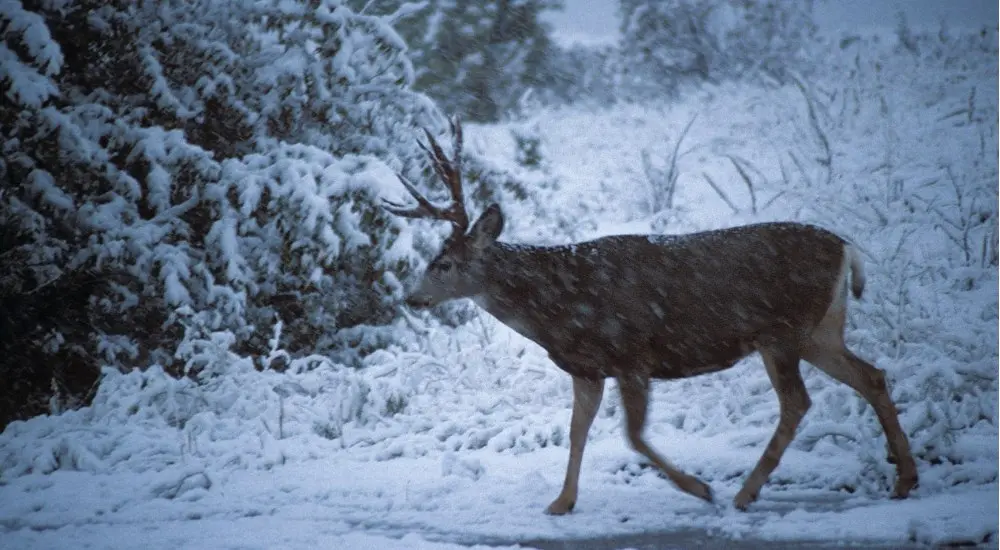
Tracking a buck starts with the tracks, but following one takes more than recognizing a hoofprint. You need to read the direction, spacing, stride, and changes in the trail as the deer moves through different ground.
This article teaches you how to read a buck’s tracks, make an educated guess between a buck and a doe track, and stay on its trail when the next print isn’t obvious.
You’ll also learn how snow, mud, and other ground conditions can change the way a track look.
Deer Hoofprints: What to Look For
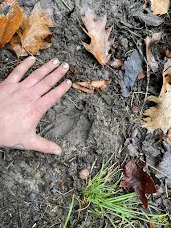
A single track can give you clues about the deer’s size and direction, but don’t try to identify the deer from one print alone. Look at several tracks together.
The pattern, spacing, depth, and direction will tell you much more.
Common Deer Track Shapes
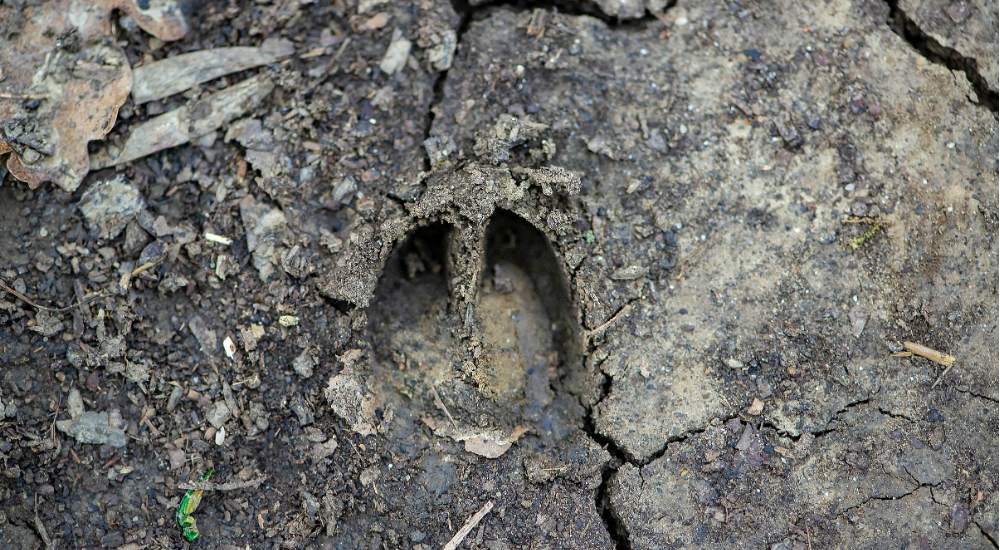
- Heart-Shaped: This is the usual deer impression, which is formed by the sharp edges of the two toes.
- Splayed Tracks: The two toes may spread wider when a deer puts more pressure on the hoof or moves quickly. Splaying can be more noticeable in larger deer, but it is not a buck-only sign.
- Dew Claw Impressions: Small marks behind the main hoof may appear when a deer is running or bounding, especially in soft mud or snow. Both bucks and does can leave them.
Front vs. Hind Deer Hoofprints
Front and hind tracks can look slightly different, which helps when you’re following a trail. The front track is generally larger than the hind track.
North Dakota Game & Fish lists front tracks at about 1⅜–4 inches long and hind tracks at about 1¼–3½ inches, although individual tracks vary.
| Feature | Front Hoof Prints | Hind Hoof Prints |
| Typical Size | Often larger | Often smaller |
| Typical Shape | Broader and rounder | Narrower and more pointed |
| Depth | Usually deeper | Shallower |
| Main Use When Tracking | Helps establish the track pattern | Helps confirm the movement pattern |
Typical Size of Deer Tracks
Whitetail tracks vary quite a bit, so there isn’t one “standard” deer track size.
Missouri Department of Conservation gives a general range of about 2½–4 inches, while North Dakota Game & Fish lists front tracks from about 1⅜–4 inches and hind tracks from about 1¼–3½ inches.
For field tracking, size is more useful as a comparison than as a pass-or-fail measurement. A consistently large, wide track is worth a closer look if you’re trying to identify a mature buck, while very small tracks may point to a fawn or younger deer.
Mud, snow, the deer’s speed, and the angle of the foot can all change the size and shape of a print. A fast-moving deer can spread its hooves, and a deer sliding through mud can leave a print that looks larger than its actual hoof.
How to Tell a Buck Track From a Doe Track
You can’t confirm a deer’s sex from one hoofprint, but you can make a better guess by looking at several tracks and the sign around them.
According to Illinois Natural History Survey field guidance on deer tracks, a mature buck track may measure around 3–4 inches long, while doe tracks are often around 2–3 inches. Fawn tracks are usually smaller, often under 2 inches.
Those numbers are not a hard rule. A large doe can overlap with a smaller buck in track size, and soft mud or snow can spread the hooves and make a print look larger.
Look for several clues together:
- Track size: Larger tracks can suggest a larger deer, but a big doe can leave a large print. Several consistently large tracks are more meaningful than one large print.
- Track width: A wider track can point toward a larger deer, especially when several prints show the same pattern.
- Depth: A deeper print can indicate more weight, but soft ground can make any deer leave a deep track.
- Splayed toes: Wider toe separation can occur when the deer puts more pressure on the hoof. It is not a buck-only sign.
- Dew claws: These may show in soft ground or when a deer is moving quickly. Bucks and does can both leave them.
- Other buck sign: Large tracks become much more interesting when you also find fresh rubs, scrapes, or other sign along the same travel route.
For example, a single 3½-inch track does not prove you’re following a buck. But several large tracks that stay consistent along the trail, combined with a fresh rub or scrape nearby, give you a much stronger reason to suspect a mature buck.
Think of track size and shape as clues, not proof. The more independent clues point in the same direction, the more confidence you can have in your read.
Common Mistakes When Identifying Buck Tracks
Through the years, some deer-tracking rules get repeated so often that they start to sound like guarantees. They aren’t.
- ”Big print equals big buck”: A large print can be a clue to a large deer, but it is not proof of a buck. Compare several tracks and check for other buck sign.
- ”Dew claws mean buck”: No. Both bucks and does can leave dew claw impressions. They are more useful for reading movement than sex, especially when they appear in soft mud or snow during faster movement.
- ”Single trail means buck”: A buck may travel alone, but so can a doe. A single trail tells you about deer’s travel route, not the proof of sex.
- ”Deep tracks mean buck”: Depth depends on the deer’s weight, the ground, and how the foot landed. Use depth as one clue, not a final answer.
- “Wider stance equals buck”: Don’t use track spacing as a buck-only sign. Speed, terrain, slope, and obstacles can all change the spacing between tracks.
The better approach is to compare several tracks and then look for other evidence along the same trail. When size, track pattern, movement, and fresh buck sign all point in the same direction, you will get a clearer conclusion.
How to Read a Deer’s Walking Pattern
Don’t focus on one hoofprint. Look at the next several tracks and the space between them.
Stride length is the distance between a deer’s steps. A walking whitetail may leave roughly 13–26 inches between steps, although the actual distance varies with the deer, terrain, and how it is moving.
Shorter, regular steps usually fit a slower walk. As the deer speeds up, the gaps between tracks become larger, and the hooves may spread more.
When a deer is running or bounding, the gaps can become much larger. Missouri Department of Conservation notes that a walking stride is about 1 foot, while a bounding deer can cover 10–15 feet between tracks.
Track depth is another clue, but don’t treat it as a weight scale. A heavier deer may leave a deeper print, but soft mud, snow, and the way the deer lands its foot can have just as much effect.
The useful part is watching for changes. If the stride suddenly gets longer, the tracks become deeper, or dewclaws start showing, stop and look around. Something about the deer’s movement or the ground may have changed.
Reading Deer Tracks in Snow and Mud
Deer tracking in snow or mud can be more informative than on a dry surface.
They can show the shape of the hoof, the direction of travel, stride length, and how much the foot was pressing into the ground.
Tracking in Snow
Fresh snow can make a track easy to follow.
Start with the toe direction, then compare the depth, spacing, and shape of several tracks. When a deer speeds up or starts bounding, the hooves may spread and the dewclaws can leave small marks behind the main print, especially in soft snow.
Don’t treat drag marks or dewclaw impressions as proof that you’re following a buck. Both bucks and does can leave these kinds of marks.
Use them to understand how the deer was moving, then combine that information with track size and other sign.
Melting, refreezing, wind, and new snowfall can also change the appearance of a track. Compare the freshest-looking prints with older sections of the trail before deciding how recently the deer passed.
Tracking in Mud
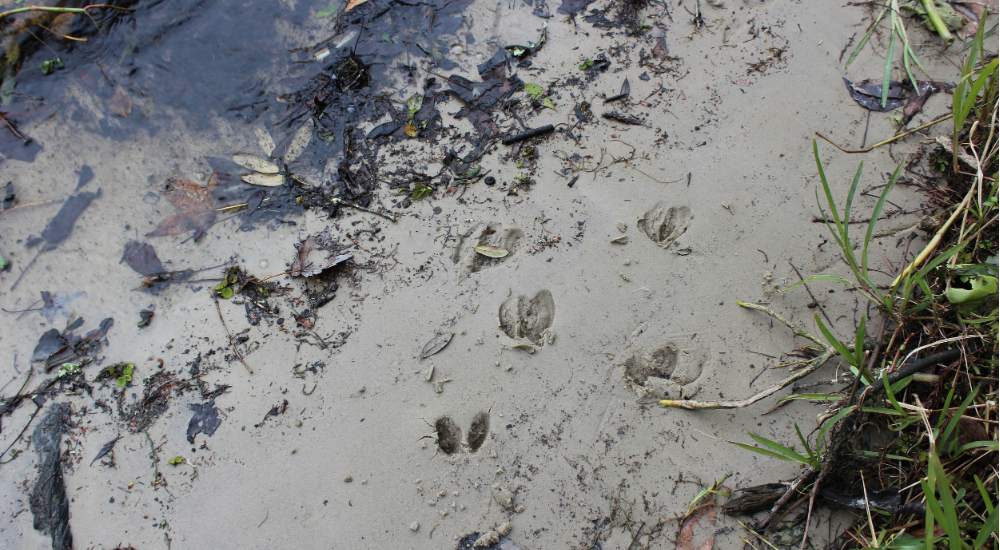
Mud can show the separation between the two toes and how much the hoof spread under pressure. Deeper prints may show where the deer placed more weight, but don’t use depth alone to identify a buck.
Keep in mind that mud can exaggerate a track. A hoof may slide forward or spread as the deer steps, making the print look longer or wider than it would on firm ground.
Once you’re reading the pattern across several tracks instead of a single print, you’re ready for the next step: staying on that trail as it moves through the woods.
How to Follow a Buck’s Tracks
Once you’ve confirmed that you’re following a fresh track line, slow down. The goal is to stay on the trail without losing the next print.
Look Ahead for the Next Track
Don’t stare at the ground directly in front of your boots. Find the last clear track, note its direction, and look ahead for where the next track should be.
On easy ground, you may see a continuous line. In leaves or thick cover, you may only find an occasional clear print. Use the direction of the last few tracks to decide where to search next.
Look farther ahead than the last clear print when the ground gets difficult.
Follow the Direction, Not the Easiest Path
A deer does not always take the trail that looks easiest to a person. If the tracks angle toward thicker cover, a creek crossing, a ridge, or another opening, follow the track line rather than cutting straight toward where you think the deer should have gone.
Slow Down When the Trail Changes
If the tracks suddenly become harder to see, don’t start walking randomly. Stop at the last clear print and search the surrounding ground before moving forward.
The slower you go, the less likely you are to walk past the next track or disturb the area before you have figured out where the deer went.
What to Do When the Tracks Disappear
Losing a track does not mean the deer disappeared. It may have simply moved onto harder ground or changed direction.
When the trail disappears:
- Stop at the last clear track. Don’t keep walking and make the trail harder to read.
- Look ahead first. Check the direction the last few tracks were pointing.
- Search both sides of the trail. A deer can make a small turn that is easy to miss.
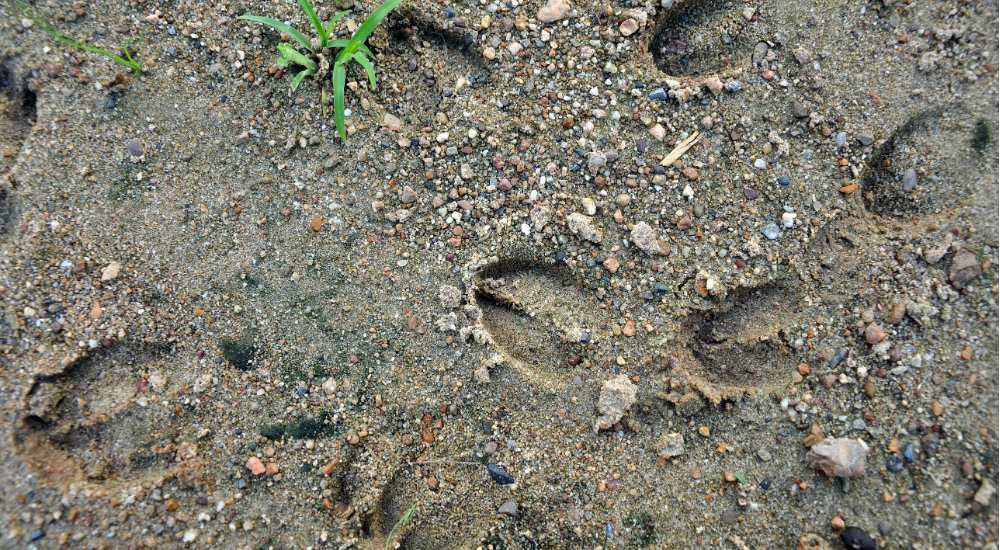
- Check changes in the ground. Look for soft dirt, mud, sand, snow, or other places that will hold a print.
- Use the terrain as a clue. Check likely travel routes such as creek crossings, ridgelines, openings, benches and cover edges, rather than searching the entire woods at random.
- Go back if necessary. If you still can’t find the next track, return to the last clear section and work forward again.
Don’t assume the biggest or most obvious path is where the deer went. Let the tracks show you the direction.
Use Other Tracking Signs to Confirm The Trail
If the tracks disappear, other deer sign can help confirm that you’re still on the right trail. Look for rubs, scrapes, beds, or other fresh sign along the route.
These signs can also help when you’re trying to decide whether a large track belongs to a mature buck. A large, consistent track line becomes more convincing when it connects with fresh buck sign.
For a deeper look at how to tell fresh rubs and scrapes from old ones, see our guide on reading deer sign and finding traveling patterns.
Conclusion
Tracking a buck is not about finding one perfect hoofprint. It is about putting several tracks together and following the trail they create.
Start with the track itself, then look at the direction, stride, spacing, and changes in the trail. If several large tracks stay consistent and you also find fresh rubs, scrapes, or other buck sign along the same route, you have a much stronger reason to believe you’re following a mature buck.
When the tracks become harder to see, slow down and work forward from the last clear print. The more trails you read in different ground conditions, the better you’ll get at recognizing what the tracks are telling you.